
What is the Marks Percentage Calculator?
The Marks Percentage Calculator works out your percentage of marks from a marksheet with several subjects. It adds up the marks you obtained and the maximum marks, gives your overall percentage or your best 5 subjects, and checks every subject against the pass mark. For example, a student can check a Class 10 or Class 12 result, or fill in an admission form that asks for a percentage.
How to calculate percentage of marks
Add up the marks you obtained, divide by the total maximum marks, and multiply by 100. Say you have six subjects, each out of 100, with 82, 76, 91, 88, 79 and 95: that is 511 out of 600, and 511 ÷ 600 × 100 = 85.17%.
This means that each subject counts in proportion to its maximum marks. To turn a single test score into a percentage, or find the score you need, use the Test Score Percentage Calculator.
How to use the marks percentage calculator
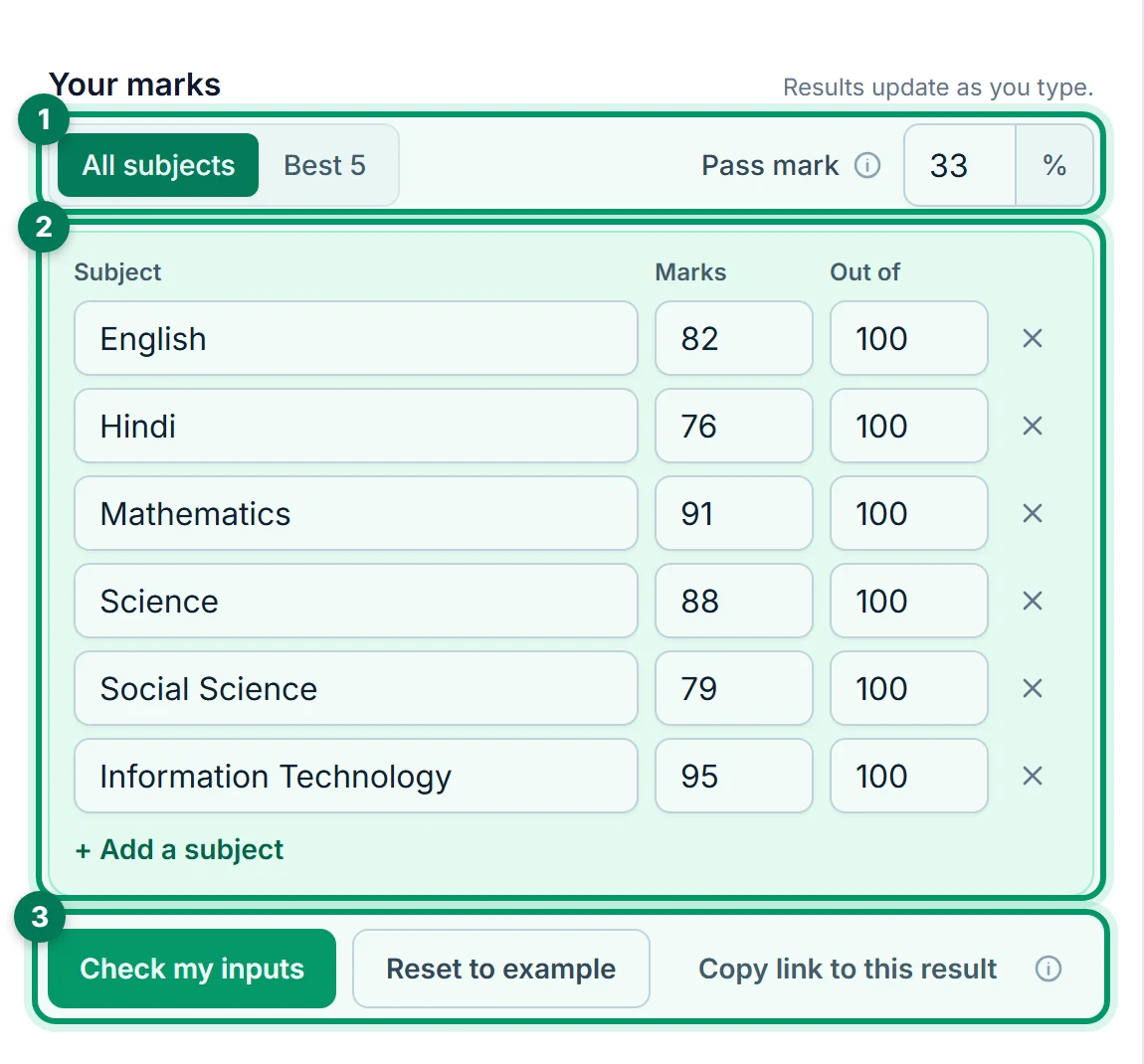
Choose what to count, and the pass mark
All subjects, or your Best 5 if your board counts them. Set the pass mark per subject, often 33%.
Enter each subject’s marks
The marks you obtained and the maximum marks. Add a subject starts with the same maximum as the row above.
Read or share the result
The result updates as you type. Copy link to this result keeps your marks in a link.
Your results, explained
Here are the results for the example: six subjects, each out of 100, with a 33% pass mark.
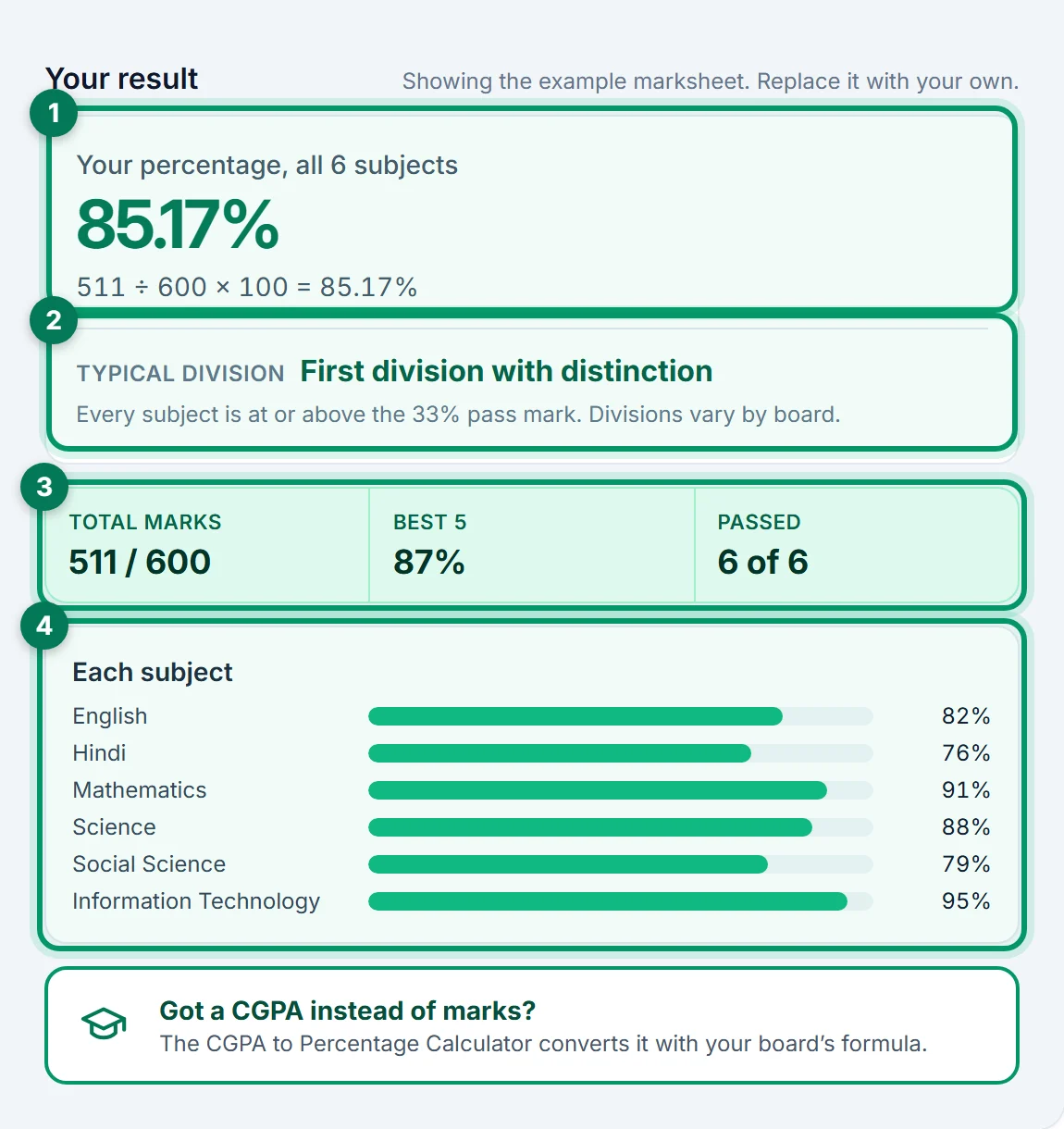
1. Your percentage is 85.17%
511 marks out of 600 across six subjects: 511 ÷ 600 × 100 = 85.17%.
2. Pass marks and division
Every subject is at or above the 33% pass mark, so the result is First division with distinction (75% or more on many boards).
If any subject is below the pass mark, this line names it instead: most boards count that as a fail, whatever the overall percentage.
3. Total, best 5 and subjects passed
For example, dropping Hindi, the lowest at 76, gives a best-of-five of 435 out of 500, which is 87%.
4. Each subject
Each subject’s percentage, highest and lowest at a glance. Red means below the pass mark; in Best 5, the subjects left out are greyed.
How each mode works: inputs and results
Answers: What is my overall percentage of marks?
Inputs
| Input | What to enter |
|---|---|
| Subject | The subject’s name, so you can tell the rows apart. Optional. Example: Mathematics |
| Marks obtained and out of | Your marks, and the maximum marks for that subject. Example: 91 out of 100 |
| Pass mark | The minimum percentage per subject, often 33%. Example: 33% |
Results
| Result | What it tells you |
|---|---|
| Percentage | Total marks obtained ÷ total maximum marks × 100. |
| Pass and division | Whether every subject passed, and the typical division for your percentage. |
| Best 5 | With six or more subjects, the percentage of your five best, for comparison. |
| Each subject | Every subject’s own percentage. |
The maths
Percentage = total marks obtained ÷ total maximum marks × 100
Subject % = marks obtained ÷ maximum marks × 100
Example
(82 + 76 + 91 + 88 + 79 + 95) ÷ 600 × 100 = 511 ÷ 600 × 100 = 85.17%.
Answers: What is my percentage counting only my five best subjects?
Inputs
| Input | What to enter |
|---|---|
| Subjects | All your subjects, six or more. The calculator picks the five with the highest percentage. Example: 6 subjects |
| Pass mark | As for All subjects. Example: 33% |
Results
| Result | What it tells you |
|---|---|
| Percentage | The five best subjects’ marks ÷ their maximum marks × 100. |
| Left out | The subjects not counted, greyed in the list. |
| All subjects | Your percentage across every subject, for comparison. |
The maths
Sort subjects by their own percentage, highest first
Best 5 % = marks of the top five ÷ their maximum marks × 100
Example
Without Hindi (76): (82 + 91 + 88 + 79 + 95) ÷ 500 × 100 = 435 ÷ 500 × 100 = 87%.
Worked example: best 5 subjects
Say you have the six subjects above and your board counts your best five. Your lowest subject is Hindi, at 76 out of 100.
Best 5 = English 82 + Mathematics 91 + Science 88 + Social Science 79 + IT 95
= 435 out of 500
Percentage = 435 ÷ 500 × 100 = 87% (85.17% with all six)
In this scenario, dropping one subject lifts the percentage by almost 2 points. For instance, some boards require a language among the five, so if Hindi had been your only language, it would have to stay in.
Pass marks, best of five and divisions
- Pass mark: often 33% per subject, as on CBSE and many state boards; some use 35% or 40%, and some need the pass mark in theory and practicals separately.
- Best of five: boards and colleges differ on which subjects must be included. The calculator picks the five highest, so check your own rule.
- Divisions: on many boards and universities, 75% or more is first division with distinction, 60% first division, 45% second division and the pass mark up to 45% third division. Treat these as a guide.
- Grades and CGPA: if your marksheet shows grades or a CGPA instead of marks, use the CGPA to Percentage Calculator.
Frequently asked questions
How do I calculate the percentage of marks?
How do I calculate the percentage of the best 5 subjects?
What if my subjects have different maximum marks?
What is the pass mark in each subject?
What percentage is first division?
Should I include practical and internal marks?
How do I convert CGPA to percentage instead?
More percentage calculators
Daily Attendance CalculatorCheck you meet the attendance rule to sit your examsOpen calculator →- CGPA to Percentage CalculatorYour marksheet shows a CGPA? Convert it here.Open calculator
- Test Score Percentage CalculatorCheck a single test instead of the whole marksheet.Open calculator
- Average Percentage CalculatorCombine percentages from several terms.Open calculator
- Percentile CalculatorRank your total against the rest of the class.Open calculator