
Percentage Increase Calculator
The Percentage Increase Calculator is used for one purpose only, to get the percentage increase of a number from an initial value to the final value. For instance, you want to know what is the percentage increase from intial value of 7 to a final value of 9, this calculator will do the computation for you.
Percentage increase = ((New Value − Original Value) ÷ Original Value) × 100.
Percentage increase = (( − ) ÷ ) × 100.
Percentage increase = %
How to Use the Percentage Increase Calculator
Since the calculator only solves a singular problem, navigating to it's usage would just be a simple task. All you ever need to do is enter the numbers and click on the Calculate button. Here's a step by step guide to it:
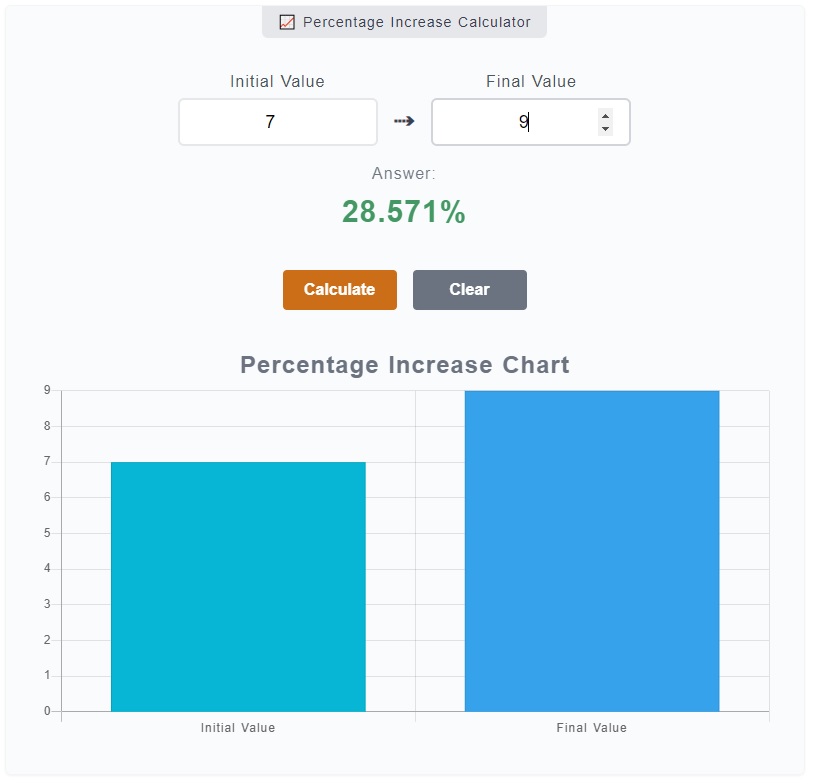
- Step 1
On the calculator, there are two (2) input fields - initial value and final value. On the initial value, enter the number from it's starting value. Enter the final value on the corresponding field as well. So for example, you want to know the percentage increase from 27 to 33. Enter
27onInitial Valueinput field and33to theFinal Valueinput field. - Step 2
After you have entered the required inputs, you can just press
Enteron your keyboard orCalculatebutton.
What is a percentage increase?
A percentage increase measures how much a value has grown compared with its original amount. It is commonly used for salary increases, price changes, sales growth, population growth, investments, and many other everyday calculations.
For example, if a product price increases from $80 to $100, the percentage increase is 25%.
Percentage increase formula
Percentage Increase = ((New Value − Original Value) ÷ Original Value) × 100
Where:
- Original Value = the starting amount
- New Value = the ending amount
How to calculate percentage increase
Follow these steps:
- Subtract the original value from the new value.
- Divide the increase by the original value.
- Multiply the result by 100.
- Add the percent sign (%).
Example 1: salary increase
Original salary: $2,000
New salary: $2,300
Increase = $2,300 − $2,000 = $300
Percentage increase = ($300 ÷ $2,000) × 100 = 15%
The salary increased by 15%.
Example 2: price increase
Original price: $50
New price: $65
Increase = $15
Percentage increase = ($15 ÷ $50) × 100 = 30%
The price increased by 30%.
Percentage increase table
| Original | New | Increase |
|---|---|---|
| $100 | $110 | 10% |
| $100 | $120 | 20% |
| $100 | $150 | 50% |
| $200 | $250 | 25% |
| $500 | $600 | 20% |
Common uses
- Salary raises
- Rent increases
- Product price changes
- Stock and investment returns
- Business revenue growth
- Population growth
- School grade improvements
Percentage increase vs. percentage decrease
A percentage increase occurs when the new value is greater than the original value.
A percentage decrease occurs when the new value is smaller than the original value.
For example:
- $100 to $120 = 20% increase
- $120 to $100 = 16.67% decrease
Notice that percentage increase and percentage decrease are not symmetrical because they use different starting values.
Frequently asked questions
How do I calculate a percentage increase quickly?
Subtract the original value from the new value, divide by the original value, then multiply by 100.
Can percentage increase be negative?
No. If the result is negative, it is a percentage decrease, not a percentage increase.
What if the original value is zero?
Percentage increase cannot be calculated when the original value is zero because division by zero is undefined.
Is percentage increase the same as growth rate?
Yes, in many contexts percentage increase and percentage growth rate are the same calculation.
Summary
A percentage increase calculator helps you determine how much a value has grown relative to its original amount. The calculation uses the formula:
Percentage Increase = ((New Value − Original Value) ÷ Original Value) × 100
This calculator is useful for financial planning, shopping, investing, business analysis, and everyday percentage calculations.
Related Percentage Calculators
Use these calculators for related percentage changes and calculations:
- Percentage Calculator — solve common percentage problems.
- Reverse Percentage Calculator — find the original value before a percentage increase.
- Fraction Percent Calculator — convert between fractions and percentages.
- Percentage Decrease Calculator — calculate how much a value decreased as a percentage.
- Percentage Change Calculator — calculate either an increase or decrease between two values.
See also: ⌚ Date Time Calculator