
What is the Daily Farm Income Calculator?
The Daily Farm Income Calculator shows what a farming season paid you for each day you worked. You enter what you sold, what you spent, your farm area and the days you worked, and it gives your income per day, per hectare per day and per calendar day, side by side with a local daily wage. For instance, a rice, corn or vegetable farmer can see whether the season paid better than wage work would have.
How much does your farm pay you a day?
Say you have 1.5 hectares of rice and sold 6,750 kg of palay at ₱22 a kilo: ₱148,500. Your costs came to ₱82,500, so the season netted ₱66,000. You worked 45 days on it, which means you earned ₱1,466.67 a day. So if the local wage is ₱450 a day, farming paid ₱1,016.67 more a day than wage work would have. With two seasons a year, that is about ₱11,000 a month. These figures are illustrative.
This means that a farm can show a profit and still pay you less than a wage, if the work takes many days. To list your costs item by item, use the Crop Production Cost Calculator.
How to use the daily farm income calculator
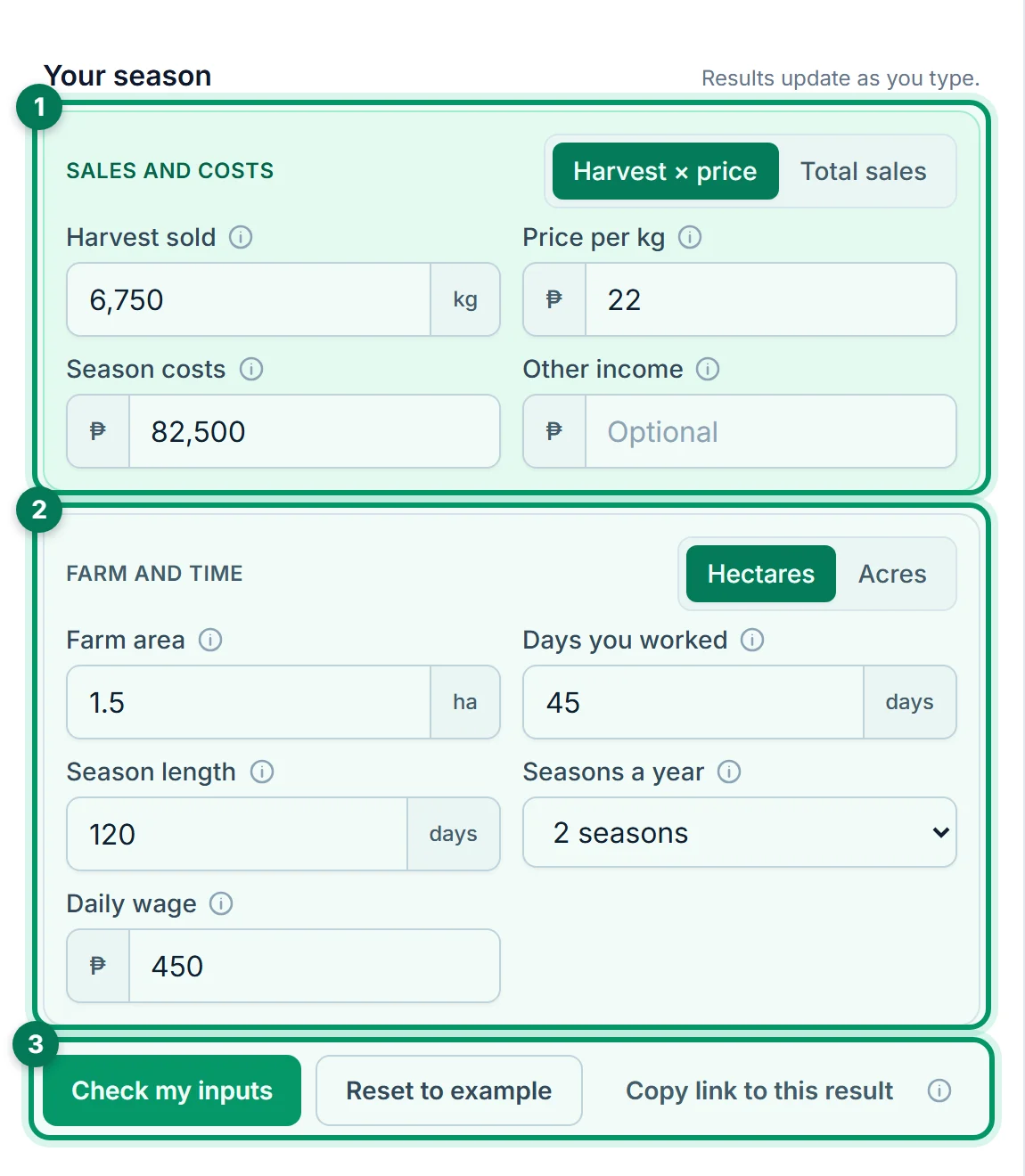
Enter your sales and costs
For one crop, choose Harvest × price and enter the kilos sold and the price. For a mixed farm, choose Total sales. Then the season’s costs.
Enter your farm and time
The farm area, the days you worked, and if you like the season length and a local daily wage to compare with.
Read or share the result
The result updates as you type. Copy link to this result keeps your season in a link, to compare with next season.
Your results, explained
Here are the results for the example: 1.5 hectares of rice in one 120-day season.
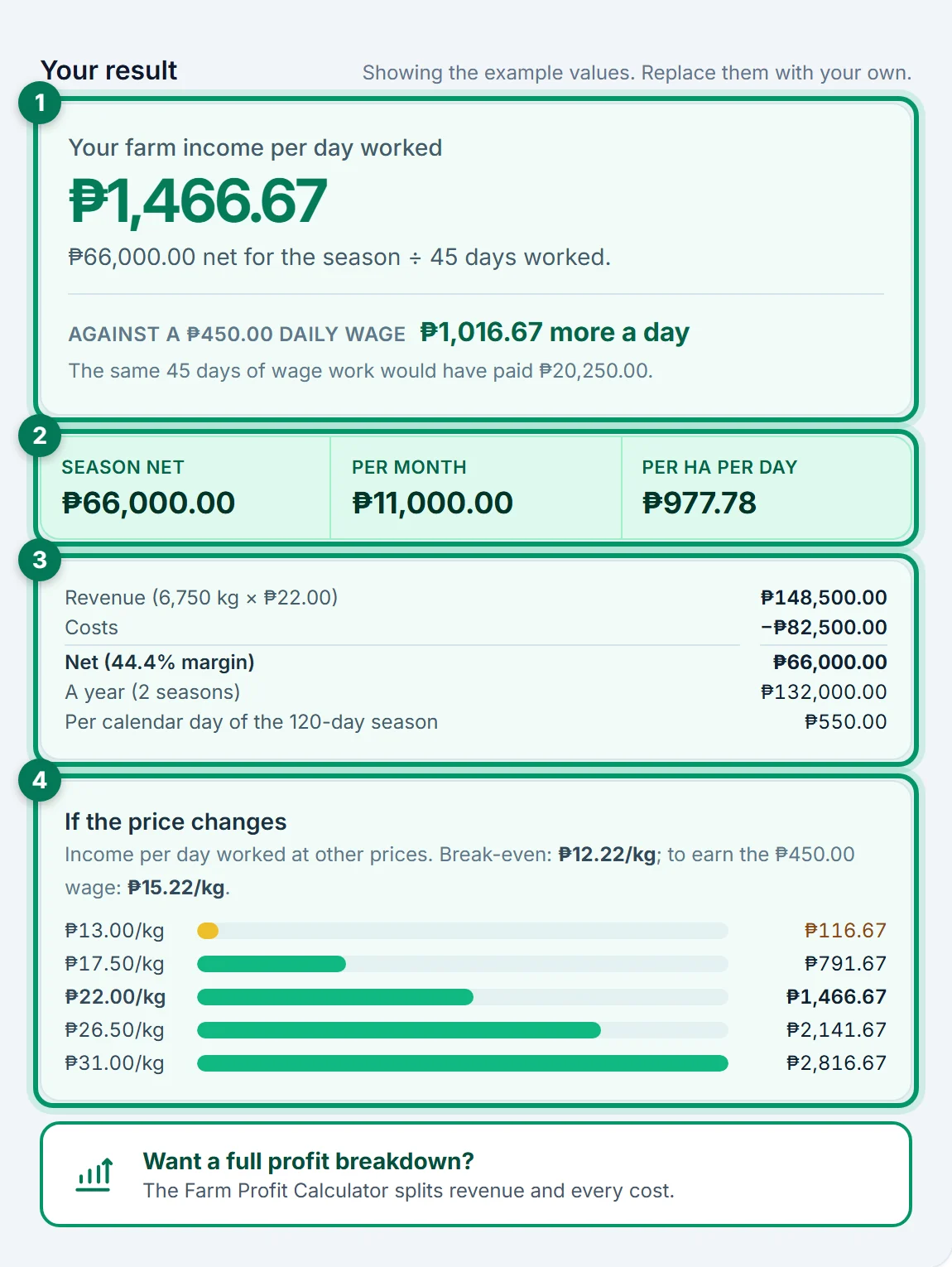
1. ₱1,466.67 per day worked
The season’s net income, ₱66,000, divided by the 45 days you worked on the farm.
Compared with a ₱450 daily wage, farming paid ₱1,016.67 more per day. This means that the same 45 days of hired work would have earned ₱20,250.
2. Season net, per month and per hectare per day
The season made ₱66,000 net. With two seasons a year that is ₱132,000, or ₱11,000 a month, the figure to set beside a salary. Per hectare per day worked it is ₱977.78.
3. Revenue, costs and the year
6,750 kg at ₱22 is ₱148,500; minus ₱82,500 in costs leaves ₱66,000, a 44.4% margin. Two seasons make ₱132,000 a year.
For example, spread over the 120-day season, the farm made ₱550 per calendar day.
4. If the price changes
Your income per day worked at prices 20% and 40% either side of yours. At ₱13 a kilo it falls to ₱116.67, still a profit but below the ₱450 wage.
This means that you can see how far the price can drop before farming pays less than wage work (below ₱15.22) or loses money (below ₱12.22, the break-even price).
How each sales mode works: inputs and results
Answers: What did one crop pay me per day I worked?
Inputs
| Input | What to enter |
|---|---|
| Harvest sold, price per kg | The kilos you sold and the farmgate price you got. Example: 6,750 kg at ₱22 |
| Other farm income (optional) | Anything else the farm earned this season, such as straw or a by-product. Example: ₱0 |
| Season costs | Everything you paid for the season: seed, fertilizer, chemicals, hired labour, rent, fuel and hauling. Example: ₱82,500 |
| Farm area | In hectares or acres. Example: 1.5 ha |
| Days you worked | The days you and your family actually worked on the farm this season. Example: 45 |
| Season length, daily wage (optional) | Planting to harvest in days, and the local daily wage for comparison. Example: 120 days, ₱450 |
| Seasons a year | How many times a year you grow this crop, for the yearly and monthly income. Example: 2 |
Results
| Result | What it tells you |
|---|---|
| Income per day worked | Net income ÷ days worked, and how it compares with the daily wage. |
| Season net, per month, per hectare per day | The season’s profit, an average month over a year of seasons, and by area. |
| Margin, year and calendar day | Profit margin, the yearly total, and the season spread over its calendar days. |
| If the price changes | Income per day worked at prices 20% and 40% either side, with the break-even price and the price that pays the wage. |
The maths
Revenue = harvest × price + other income
Net = revenue − costs
Per day worked = net ÷ days worked
Per month = net × seasons a year ÷ 12
Break-even price = (costs − other income) ÷ harvest
Price for the wage = (costs − other income + wage × days worked) ÷ harvest
Example
6,750 × ₱22 = ₱148,500; − ₱82,500 = ₱66,000; ÷ 45 days = ₱1,466.67 a day.
Answers: What did a farm with several crops or animals pay me per day?
Inputs
| Input | What to enter |
|---|---|
| Total sales | Everything the farm sold this season, from all crops and animals. Example: ₱148,500 |
| Costs, area, days and wage | As for Harvest × price. Example: ₱82,500; 1.5 ha; 45 days; ₱450 |
Results
| Result | What it tells you |
|---|---|
| Income per day worked | As for Harvest × price. |
| Season net, per month, per hectare per day | As for Harvest × price. |
| Margin and year | Net ÷ revenue, and the yearly total. The price lines need a single crop, so they are left out. |
The maths
Net = total sales + other income − costs
Per day worked = net ÷ days worked
Example
₱148,500 − ₱82,500 = ₱66,000; ÷ 45 = ₱1,466.67 a day.
Worked example: the same farm at a low price
For example, the same 1.5 hectares in a season when the farmgate price drops to ₱11 a kilo.
Sales: 6,750 kg × ₱11 = ₱74,250
Net: ₱74,250 − ₱82,500 = −₱8,250
−₱183.33 per day worked: below the ₱12.22 break-even price
In this scenario, the season loses money before you count your own work. The break-even line tells you the price to wait for, or the costs to cut.
Ways to raise your income per day
- Know your break-even price before you sell. If buyers offer less, compare storing and selling later with the crop storage comparison.
- Cut the costs that don’t add yield. The Crop Production Cost Calculator shows where the money goes.
- Count your days honestly. Include land preparation, spraying, watching the field and selling. Fewer days for the same profit is a higher daily income.
- Compare crops fairly. A crop that earns more per season but takes twice the days can pay less per day. For instance, run each crop here and compare the per-day figures.
Frequently asked questions
Is farming profitable?
How do I work out my farm income per day?
Should I count my own and my family’s labour?
What costs should I include?
How do I work out my monthly income from farming?
What is the break-even price?
Which farming is most profitable?
Farm income and profit calculators
Keep planning with the tools that answer the next question.
- Farm Profit CalculatorRevenue, every cost and the profit for a crop or season. Open calculator
- Crop Production Cost CalculatorList the season’s costs item by item, per hectare and in total. Open calculator
- Crop Revenue CalculatorWhat a harvest sells for from yield and price. Open calculator
- Farm Break-even CalculatorThe price or yield you need to cover your costs. Open calculator
- Farm ROI and Payback CalculatorThe return on a farm investment and how long it takes to pay back. Open calculator
- Crop Storage vs Sell Now CalculatorWhether storing the harvest for a better price pays. Open calculator
- Coconut Income and Profit CalculatorIncome and profit from a coconut farm. Open calculator