
What is the APY Calculator?
The APY Calculator turns an interest rate and how often it compounds into the APY, the yearly rate you actually earn. It can also turn an advertised APY back into its APR, and compare two accounts that quote their rates differently, in percentages and in money on your balance.
4.5% compounded monthly beats a 4.55% APY
One bank offers 4.5% interest compounded monthly. Another advertises a 4.55% APY. The second looks better, but the first bank’s 4.5% is an APR, the rate before compounding. Compounded monthly, it becomes a 4.59% APY, so on 10,000 the first account earns 4.40 more in the first year.
APY puts every account on the same footing, because it already includes how often interest is added. When you compare accounts, you can also add each one’s monthly fee and introductory offer, which often decide the winner. To see what a balance earns or costs per day, use the Daily Interest Calculator.
How to use the calculator
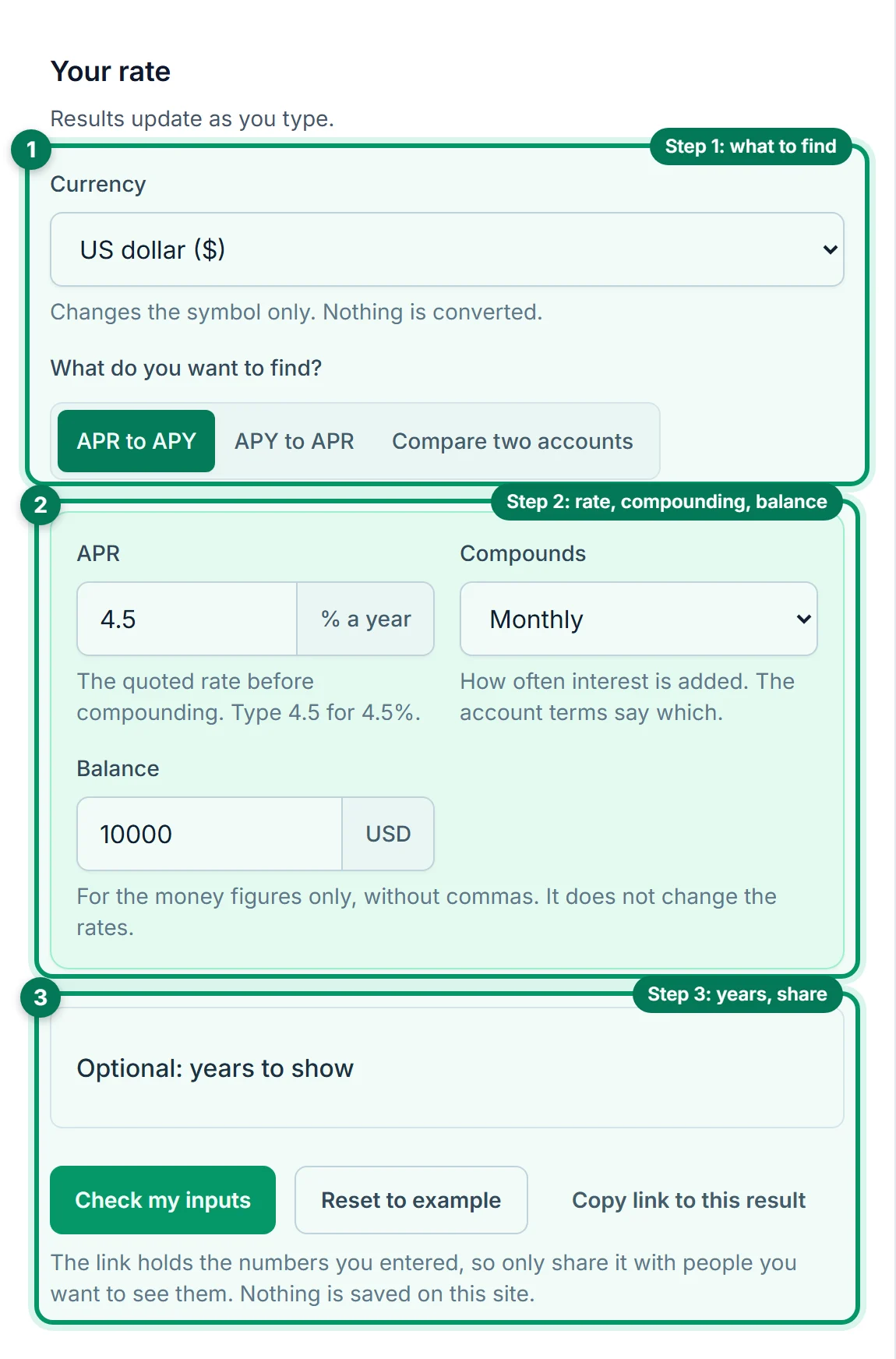
Choose what to find
Pick your Currency. Under What do you want to find?, choose APR to APY, APY to APR or Compare two accounts.
Enter the rate, compounding and balance
Enter the APR or APY, typing 4.5 for 4.5%, and choose how often it Compounds. To compare, fill in Account A and Account B, choosing APR or APY for each, and add any monthly fee or tick has an introductory rate. Then enter the Balance, which only affects the money figures.
Set the years, then read or share the result
Open Optional: years to show to change the 5-year chart and table. Results update as you type, and Copy link to this result gives a link with your numbers in it. The next section explains every number.
Your results, explained
Here are the results for the example values: a 4.5% APR compounded monthly on a 10,000 balance, shown over 5 years. Each numbered explanation matches a highlighted area in the image.
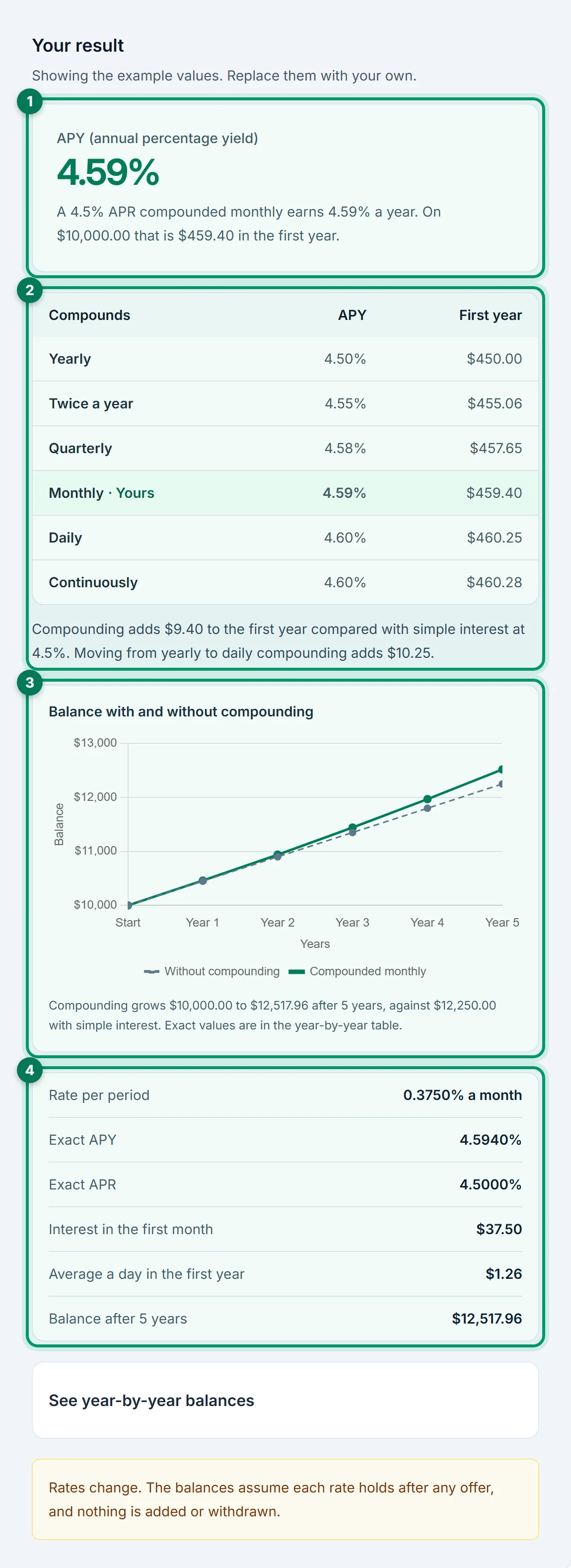
1. APY: 4.59%
The yearly rate after compounding: (1 + 0.045 ÷ 12)^12 − 1 = 4.5940%, shown to two decimals as 4.59%. The note turns it into money: 10,000 × 4.5940% = 459.40 in the first year. This is the figure to compare between accounts.
2. Same rate, different compounding: 4.50% to 4.60%
The table applies your 4.5% rate at every compounding frequency, with your choice marked. Yearly compounding gives 4.50% and daily gives 4.60%, so on 10,000 the gap is 450.00 vs 460.25. The note shows compounding adds 9.40 to the first year compared with simple interest.
3. The chart: 12,517.96 after 5 years
The green line is the balance compounding monthly; the dashed line is simple interest with nothing compounded. They start together and pull apart each year: 12,517.96 vs 12,250.00 after 5 years. Change the years under Optional: years to show.
4. Rate per period, monthly interest and exact figures
Monthly compounding means 4.5% ÷ 12 = 0.3750% a month, applied 12 times a year. On 10,000 that is 37.50 in the first month, or 1.26 a day on average over the first year. The exact APY and APR to four decimals and the balance after 5 years let you check the result by hand.
How each mode works: inputs and results
The calculator has three modes, chosen under What do you want to find? Each one asks for different inputs and gives different results. Pick a mode below to see exactly what it needs and what it shows. Every mode works with Copy link to this result.
Answers: What does a quoted rate earn in a year once compounding is included?
Inputs
| Input | What to enter |
|---|---|
| Currency | The symbol shown on amounts. Nothing is converted. Example: US dollar ($) |
| APR | The yearly rate before compounding, as a percentage. Type 4.5 for 4.5%. Example: 4.5 |
| Compounds | How often interest is added to the balance: Daily, Monthly, Quarterly, Twice a year, Yearly or Continuously. The account terms say which. Example: Monthly |
| Balance | The amount in the account, without commas. Used for the money figures only; it does not change the rates. Example: 10000 |
| Optional: years to show | Whole years from 1 to 50 for the chart and the year-by-year table. Blank means 5. Example: 5 |
Results
| Result | What it tells you |
|---|---|
| APY (annual percentage yield) | The main result: the yearly rate after compounding, to two decimals. The note shows the first-year interest on your balance. |
| Same rate, different compounding | Your APR at every compounding frequency, with its APY and first-year interest, and your choice marked. |
| Compounding note | How much compounding adds to the first year, and how much daily adds over yearly. |
| Balance with and without compounding (chart) | The balance at each year end, compounded and with simple interest. |
| Rate per period, Exact APY, Exact APR, Interest in the first month, Average a day in the first year, Balance after the years | The figures behind the result, including what the balance earns in a month and a day, then the year-by-year table. |
The maths
APY = (1 + APR ÷ n)^n − 1, where n is the compounding periods a year (365, 12, 4, 2 or 1)
Continuously: APY = e^APR − 1
Balance after t years = balance × (1 + APY)^t
Example
A 4.5% APR compounded monthly gives a 4.59% APY. On 10,000 that is 37.50 in the first month, 459.40 in the first year and 12,517.96 after 5 years.
Answers: What rate before compounding sits behind an advertised APY?
Inputs
| Input | What to enter |
|---|---|
| Currency | The symbol shown on amounts. Nothing is converted. Example: US dollar ($) |
| APY | The advertised yearly yield, as a percentage. Type 4.6 for 4.6%. Example: 4.6 |
| Compounds | How often interest is added to the balance: Daily, Monthly, Quarterly, Twice a year, Yearly or Continuously. The account terms say which. Example: Monthly |
| Balance | The amount in the account, without commas. Used for the money figures only; it does not change the rates. Example: 10000 |
| Optional: years to show | Whole years from 1 to 50 for the chart and the year-by-year table. Blank means 5. Example: 5 |
Results
| Result | What it tells you |
|---|---|
| APR (the rate before compounding) | The main result: the yearly rate that compounds to your APY. The note gives the rate per period. |
| Same APY, different compounding | The APR that gives your APY at every compounding frequency, with your choice marked. |
| Compounding note | How far the APR falls as compounding gets more frequent. |
| Balance with and without compounding (chart) | The balance at each year end at your APY, and with simple interest at the APR. |
| Rate per period, Exact APY, Exact APR, Interest in the first month, Average a day in the first year, Balance after the years | The figures behind the result, then the year-by-year table. |
The maths
APR = n × ((1 + APY)^(1 ÷ n) − 1)
Continuously: APR = ln(1 + APY)
Rate per period = APR ÷ n
Example
A 4.6% APY with monthly compounding comes from a 4.51% APR, which is 0.3755% a month.
Answers: Which of two accounts really pays more when they quote rates differently?
Inputs
| Input | What to enter |
|---|---|
| Currency | The symbol shown on amounts. Nothing is converted. Example: US dollar ($) |
| Account A rate and Account B rate | Each account’s quoted rate. Type 4.5 for 4.5%. Example: 4.5 and 4.55 |
| Account A rate is and Account B rate is | APR or APY, as each bank quotes it. Example: APR and APY |
| Account A compounds and Account B compounds | Shown when the rate is an APR: how often that account compounds. An APY already includes compounding. Example: Monthly |
| Account A monthly fee and Account B monthly fee | Optional. The account fee charged each month; leave blank if there is none or your balance avoids it. Example: 5 |
| Account A has an introductory rate (and B) | Optional. Tick it for a teaser offer, then enter the Introductory rate (same type and compounding as the rate) and the Months at the introductory rate, 1 to 24. The rate above becomes the rate after the offer. Example: 6 for 12 months |
| Balance | The amount in the account, without commas. Used for the money figures only; it does not change the rates. Example: 10000 |
| Optional: years to show | Whole years from 1 to 50 for the chart and the year-by-year table. Blank means 5. Example: 5 |
Results
| Result | What it tells you |
|---|---|
| Account A (or B) leaves you with more in the first year | The main result: the first-year difference in money after offers and fees. The note gives both first-year yields and who is ahead after your years, which can be the other account. |
| Side-by-side table | Each account as entered, its first-year yield, the interest it leaves you in the first year and its balance after your years. |
| Balance in each account (chart) | Both balances at each year end, with the gap between them shaded. |
| APYs, introductory APYs, fees and the year-by-year table | Each APY to four decimals, any introductory APY and first-year fees, then every year’s balances and difference. |
The maths
Each account’s APY from its rate and compounding, as in APR to APY
Each month: balance × (1 + APY)^(1 ÷ 12), using the introductory APY during the offer, minus the monthly fee
First-year yield = balance after 12 months ÷ starting balance − 1
Example
A 4.5% APR compounded monthly (4.59% APY) beats a 4.55% APY by 4.40 in the first year on 10,000. Add a 5 monthly fee to it and a 4.25% APY with no fee wins by 26.85.
Worked example: 4.5% compounded monthly
These are the calculator’s example values, and they are illustrative only. An account quotes 4.5% interest, compounded monthly, and you keep 10,000 in it.
Rate per month = 4.5% ÷ 12 = 0.375%
Growth in a year = 1.0037512 = 1.045940
APY = 1.045940 − 1 = 4.5940%, shown as 4.59%
First-year interest = 10,000 × 4.5940% = 459.40
Simple interest at 4.5% would pay 450.00, so monthly compounding adds 9.40 in the first year. Keep the money there and it keeps compounding: 12,517.96 after 5 years, against 12,250.00 with simple interest.
Compare APY with APY, never APR with APY
Banks quote savings rates in different ways, so put both on the same footing before choosing. Choose Compare two accounts and enter each one as its bank quotes it.
| Account | APY | First year | After 5 years |
|---|---|---|---|
| A: 4.5% APR, monthly | 4.59% | 459.40 | 12,517.96 |
| B: 4.55% APY | 4.55% | 455.00 | 12,491.66 |
Account A pays 4.40 more in the first year and 26.30 more after 5 years, even though its headline number is lower. The gap is small here, so fees, minimum balances and how long the rate is guaranteed may matter more.
Fees and introductory rates can flip the answer
The higher APY is not always the account that leaves you with more. Two things change the result, and both go into Compare two accounts.
A monthly fee
Give the 4.59% account a monthly fee of 5 and compare it with a 4.25% APY that has no fee. The fee takes 60 a year, so the first account keeps 398.15 of interest on 10,000, a first-year yield of 3.98%. The 4.25% account keeps 425.00 and wins by 26.85 in the first year and 131.24 after 5 years.
An introductory rate
Suppose one account offers 6% for 12 months, then 3.5%, against a steady 4.5%. Tick has an introductory rate, enter 6 for 12 months and 3.5 as the rate after the offer. The offer wins the first year, 600.00 against 450.00. But after 5 years the steady account is 298.08 ahead, and the result says so. A shorter offer is weaker still: 5.25% for 6 months, then 3.5%, gives a first-year yield of only 4.37%.
The calculation assumes the rate after the offer stays the same. If you plan to move the money when the offer ends, compare the first year only.
Turning an APY back into an APR
Sometimes you need the rate behind an APY, for example to work out one month’s interest. Choose APY to APR, enter the APY and the compounding. A 4.6% APY compounded monthly comes from a 4.51% APR:
APR = 12 × (1.0461 ÷ 12 − 1) = 4.5058%
Rate per month = 4.5058% ÷ 12 = 0.3755%
The more often an account compounds, the lower the APR behind the same APY: from 4.60% with yearly compounding down to 4.50% with daily.
How much does compounding frequency matter?
Less than most people expect. Here is a 4.5% APR at each frequency, with the first-year interest on 10,000:
| Compounds | APY | First year |
|---|---|---|
| Yearly | 4.50% | 450.00 |
| Quarterly | 4.58% | 457.65 |
| Monthly | 4.59% | 459.40 |
| Daily | 4.60% | 460.25 |
| Continuously | 4.60% | 460.28 |
Going from yearly to daily adds 10.25 a year on 10,000. Going from 4.5% to 5%, both monthly, adds 52.22. Chase the rate first; the compounding frequency is a tiebreaker.
Before relying on the result
- An APY entered as an APR. Check the wording: “APY” or “annual percentage yield” already includes compounding.
- The wrong compounding. The account terms say how often interest is added; monthly and daily are common.
- Promotional rates in the conversion modes. APR to APY and APY to APR assume one rate all year. Use Compare two accounts with an introductory rate instead.
- Fees you didn’t enter. APY itself ignores fees. Add the monthly fee in Compare, or check whether your balance avoids it.
Before you choose an account:
- Compare APYs, not an APR with an APY.
- Check how long the rate is guaranteed.
- Enter any monthly fee and introductory offer in Compare.
- Work out the difference in money on your own balance.
Sources
- Regulation DD (Truth in Savings), Appendix A: Annual Percentage Yield calculation Supports the APY as a yearly rate including compounding, based on a 365-day year (366 allowed in a leap year).
Sources checked on 20 November 2026.
Frequently asked questions
What is the difference between APR and APY?
Which number should I compare between savings accounts?
How much does daily compounding beat monthly?
What does compounding continuously mean?
Why is my bank’s APY slightly different from the result?
Does APY include fees?
How do introductory rates change the comparison?
How much interest will I earn each month?
Is anything saved when I copy a link to my result?
Does changing the currency convert my amounts?
Related interest and savings calculators
Keep planning with the tools that answer the next question.
- Daily Interest CalculatorSee what a balance earns or costs each day, compare two rates, or check a statement. Open calculator
- CAGR CalculatorFind the yearly growth rate between two values, or project one forward. Open calculator
- Dividend Reinvestment CalculatorSee how income grows when every payout is reinvested. Open calculator
- Dollar-Cost Averaging CalculatorPlan a fixed amount invested on a schedule and compare it with a lump sum. Open calculator