
What is the Daily Interest Calculator?
The Daily Interest Calculator shows how much interest a balance earns or costs in one day. Enter the balance, its yearly rate as an APR or APY, and a number of days or two dates. It works out the daily rate, the interest per day and the total for your period, with and without daily compounding. It can also work backwards to the savings needed for a daily income, compare two rates to show what each day at the worse one costs, or check which method your bank used for the interest on a statement.
4.5% a year is about 1.23 a day on 10,000
Your savings account pays 4.5% a year on 10,000. That sounds like 450 a year, but the bank works it out one day at a time: 10,000 × 4.5% ÷ 365 = 1.23 a day. A debt works the same way. A 2,000 card balance at 24.99% costs about 1.37 for every day it stays unpaid.
Seeing the daily figure helps when you are deciding whether to move savings, pay a bill a week early, or let a balance sit until payday. The calculator assumes one balance for the whole period. If the balance changes with deposits, purchases or payments, use the average daily balance from your statement.
How to use the calculator
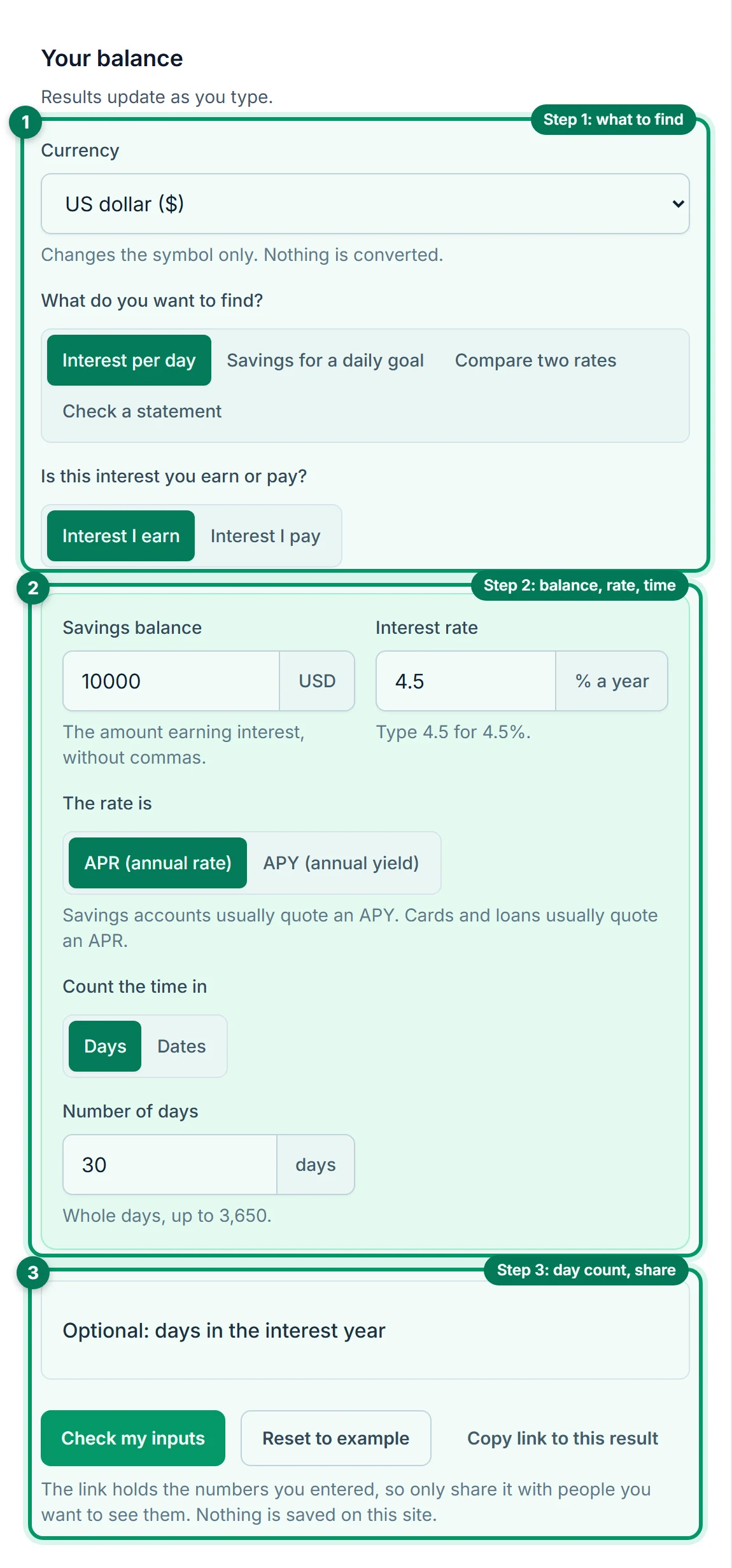
Choose what to find
Pick your Currency. Under What do you want to find?, choose Interest per day, Savings for a daily goal, Compare two rates or Check a statement. Then choose Interest I earn for savings or Interest I pay for a loan or card. This changes the wording only, not the maths.
Enter the balance, rate and time
Enter the Savings balance or Amount owed and the Interest rate, typing 4.5 for 4.5%. Under The rate is, choose APR (annual rate) or APY (annual yield) to match what your bank quotes. Then enter the Number of days, or choose Dates and pick a Start date and End date. For a daily goal, enter the Interest you want each day instead of a balance. To compare, enter your Current rate and the New rate. To check a statement, enter the Average daily balance and the Interest on your statement.
Check the day count, then read or share the result
If your loan agreement divides the APR by 360, open Optional: days in the interest year. Results update as you type. Copy link to this result gives a link with your numbers in it. The next section explains every number.
Your results, explained
Here are the results for the example values: a 10,000 savings balance at a 4.5% APR, divided by 365, for 30 days. Each numbered explanation matches a highlighted area in the image.
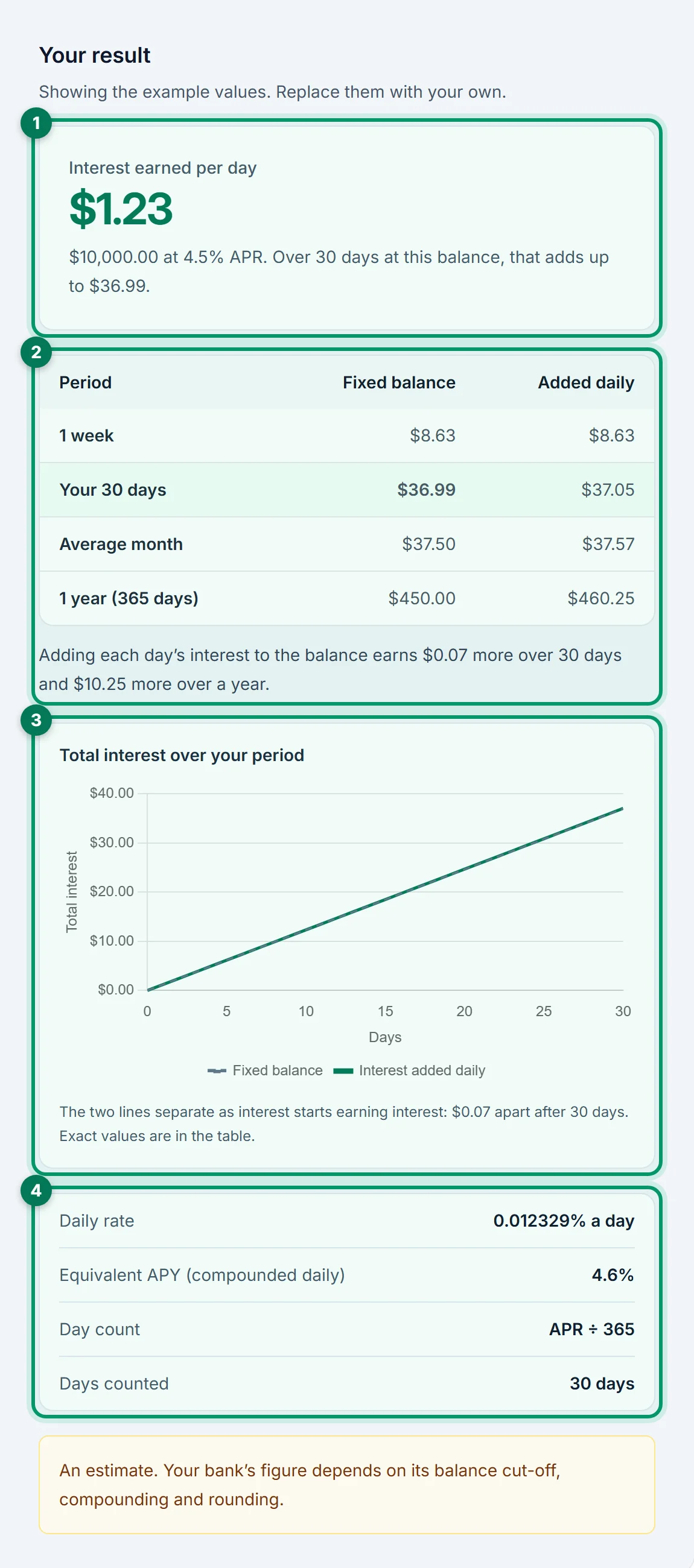
1. Interest per day: 1.23
The balance times the daily rate: 10,000 × 4.5% ÷ 365 = 1.2329, shown as 1.23. The note multiplies it by your 30 days: 1.2329 × 30 = 36.99. That is what the balance earns if it stays at 10,000 for the whole period.
2. Interest over time: 36.99 or 37.05 for 30 days
The Fixed balance column multiplies the daily interest by the days. The Added daily column adds each day’s interest to the balance first, so later days earn a little more. Over 30 days the gap is only 0.07, but over a year it is 10.25: 450.00 vs 460.25. Use the column that matches how your account or loan treats interest.
3. The chart: 36.99 vs 37.05 after 30 days
The dashed line is the total with a fixed balance and the green line is the total with interest added daily. Over 30 days they almost overlap, 0.07 apart, which shows that compounding barely matters over a month. Enter 365 or more days to watch them separate. In Compare two rates, the chart shades the gap between the two rates instead.
4. Daily rate, equivalent APY and day count
The daily rate is 4.5% ÷ 365 = 0.012329% a day. Compounded every day for 365 days, that APR gives an APY of 4.6%. The day-count line shows whether the rate was divided by 365 or 360, and how many days were counted.
How each mode works: inputs and results
The calculator has four modes, chosen under What do you want to find? Each one asks for different inputs and gives different results. Pick a mode below to see exactly what it needs and what it shows. Every mode works with Copy link to this result.
Answers: How much interest does my balance earn or cost each day, and over my period?
Inputs
| Input | What to enter |
|---|---|
| Currency | The symbol shown on amounts. Nothing is converted. Example: US dollar ($) |
| Is this interest you earn or pay? | Interest I earn for savings, Interest I pay for a loan or card. It changes the wording only. Example: Interest I earn |
| Savings balance or Amount owed | The balance that earns or is charged interest, without commas. For a card, use the average daily balance. Example: 10000 |
| Interest rate | The yearly rate as a percentage. Type 4.5 for 4.5%. Example: 4.5 |
| The rate is | APR (annual rate) or APY (annual yield), matching what the bank quotes. Example: APR (annual rate) |
| Count the time in | Days, then the Number of days (1 to 3,650). Or Dates, then a Start date and End date; each night in between counts as one day. Example: Days, 30 |
| Optional: days in the interest year | Divide the APR by 365 days or 360 days. Used with an APR only. Example: 365 days |
Results
| Result | What it tells you |
|---|---|
| Interest earned per day (or Interest charged per day) | The main result: balance × daily rate. The note adds it up over your period at a fixed balance. |
| Interest over time table | 1 week, your period, an average month (30.42 days) and 1 year, each with a Fixed balance and with interest Added daily. |
| Compounding note | How much more adding each day’s interest to the balance gives over your period and over a year. |
| Total interest over your period (chart) | The two totals drawn day by day, so you can see when compounding starts to matter. |
| Daily rate, Equivalent APY or APR, Day count, Days counted | The figures behind the result, for checking it by hand. |
The maths
Daily rate = APR ÷ 365 (or 360); from an APY, (1 + APY)^(1 ÷ 365) − 1
Interest per day = balance × daily rate
Fixed balance total = interest per day × days
Added daily total = balance × ((1 + daily rate)^days − 1)
Example
10,000 at a 4.5% APR for 30 days earns 1.23 a day: 36.99 over the 30 days at a fixed balance, or 37.05 with interest added daily.
Answers: How much do I need saved to earn a set amount of interest each day?
Inputs
| Input | What to enter |
|---|---|
| Currency | The symbol shown on amounts. Nothing is converted. Example: US dollar ($) |
| Interest you want each day | Your daily interest target, without commas. Example: 50 |
| Interest rate | The yearly rate you expect, above 0. Type 4.5 for 4.5%. Example: 4.5 |
| The rate is | APR (annual rate) or APY (annual yield), matching what the bank quotes. Example: APR (annual rate) |
| Optional: days in the interest year | Divide the APR by 365 days or 360 days. Used with an APR only. Example: 365 days |
The earn-or-pay choice and the period are not used in this mode.
Results
| Result | What it tells you |
|---|---|
| Savings needed to earn … a day | The main result: the balance that earns your daily target at this rate. |
| Interest over time table | What that balance earns in 1 week, an average month and 1 year, at a fixed balance and with interest added daily. |
| Compounding note | How much more the balance earns over a year if you leave each day’s interest in. |
| Interest per day if you leave the interest in (chart) | How the daily interest climbs above your goal over 5 years when nothing is withdrawn. |
| Daily rate, Equivalent APY or APR, Day count, Check | The check line multiplies the balance by the daily rate to show it gives your target. |
The maths
Daily rate = APR ÷ 365 (or 360); from an APY, (1 + APY)^(1 ÷ 365) − 1
Savings needed = daily target ÷ daily rate
Interest per day after t days, interest left in = savings × (1 + daily rate)^t × daily rate
Example
50 a day at a 4.5% APR needs 405,555.56. That earns 1,520.83 in an average month and 18,250.00 a year. Left in the account, it earns 62.62 a day after 5 years.
Answers: How much does each day at my current rate cost me compared with a better one?
Inputs
| Input | What to enter |
|---|---|
| Currency | The symbol shown on amounts. Nothing is converted. Example: US dollar ($) |
| Is this interest you earn or pay? | Interest I earn for savings, Interest I pay for a loan or card. It changes the wording only. Example: Interest I earn |
| Savings balance or Amount owed | The balance both rates apply to, without commas. Example: 10000 |
| Current rate | What your account pays or your card or loan charges now. Example: 0.5 |
| New rate | The rate you could switch to. Example: 4.5 |
| Both rates are | APR (annual rate) or APY (annual yield). Both rates must be the same type. Example: APR (annual rate) |
| Count the time in | Days, then the Number of days (1 to 3,650). Or Dates, then a Start date and End date; each night in between counts as one day. Example: Days, 30 |
| Optional: days in the interest year | Divide the APR by 365 days or 360 days. Used with an APR only. Example: 365 days |
Results
| Result | What it tells you |
|---|---|
| Extra interest per day at the new rate (or Interest saved, Interest lost, Difference per day) | The main result: the gap per day. The wording shows whether switching helps you. |
| Comparison table | Interest at each rate and the difference for 1 week, your period, an average month and 1 year, at a fixed balance. |
| Compounding note | The yearly gap if each day’s interest is added to the balance. |
| Total interest at each rate (chart) | Both totals day by day, with the gap between them shaded. |
| Daily rate now, Daily rate at the new rate, Equivalent APYs or APRs, Day count, Days counted | Each rate’s daily figures, for checking by hand. For debt, a note reminds you to allow for switching fees. |
The maths
Interest per day at each rate = balance × that rate’s daily rate
Difference per day = new interest per day − current interest per day
Difference over n days = difference per day × n
Example
10,000 at 0.5% instead of 4.5% (APR) costs 1.10 a day: 32.88 over 30 days and 400.00 over a year, or 410.12 with interest added daily.
Answers: Which method did my bank use for the interest on my statement?
Inputs
| Input | What to enter |
|---|---|
| Currency | The symbol shown on amounts. Nothing is converted. Example: US dollar ($) |
| Is this interest you earn or pay? | Interest I earn for savings, Interest I pay for a loan or card. It changes the wording only. Example: Interest I earn |
| Average daily balance | From your statement. If it isn’t shown, use the balance for the period. Example: 10000 |
| Interest rate | The rate on your statement. Type 4.5 for 4.5%. Example: 4.5 |
| The rate is | APR (annual rate) or APY (annual yield), matching what the bank quotes. Example: APR (annual rate) |
| Count the time in | Days, then the Number of days (1 to 3,650). Or Dates, then a Start date and End date; each night in between counts as one day. Example: Days, 30 |
| Interest on your statement | The interest paid or charged for the period, as printed. Example: 37.05 |
The day-count option is not needed here: the check tries both 365 and 360.
Results
| Result | What it tells you |
|---|---|
| Your statement matches (or No standard method matches) | The main result: the method that gives your statement figure, how many methods match, or the closest one. |
| Methods table | The interest from each method on the same balance and days, how far it is from your statement, and · Match where it fits. |
| Rate your statement implies | The yearly rate that gives your statement figure on a fixed balance divided by 365. A big gap from your rate points to a wrong input. |
| Counts as a match within, Days counted | The rounding allowance used, and the days the check used. |
The maths
Methods tried with an APR: ÷ 365 or ÷ 360, each with a fixed balance or interest added daily; with an APY: fixed or added daily
Match allowance = 0.02 or 0.1% of the statement figure, whichever is larger
Implied rate = statement interest ÷ balance ÷ days × 365
Example
10,000 at a 4.5% APR for 30 days with 37.05 on the statement matches APR ÷ 365 with interest added daily. The allowance is 0.04, and the statement implies a rate of 4.51%.
Worked example: 10,000 in savings for 30 days
These are the calculator’s example values, and they are illustrative only. The account pays a 4.5% APR, the bank divides it by 365, and the balance stays at 10,000 for 30 days.
Daily rate = 4.5% ÷ 365 = 0.012329% a day
Interest per day = 10,000 × 0.00012329 = 1.2329, shown as 1.23
Fixed balance, 30 days = 1.2329 × 30 = 36.99
Added daily, 30 days = 10,000 × (1.0001232930 − 1) = 37.05
The two totals differ by only 0.07 because a month of interest is too small to earn much interest of its own. Over a full year the gap grows to 10.25, which is why the same 4.5% APR is advertised as a 4.6% APY when the bank compounds daily.
APR or APY? Enter the rate your bank quotes
An APR is the simple yearly rate before compounding. An APY is the yearly yield after compounding, so it is slightly higher for the same account. Mixing them up overstates or understates every daily figure.
Suppose a savings account advertises a 5% APY on 10,000. Choose APY (annual yield), and the calculator finds the daily rate that grows to exactly 5% over 365 days: 0.013368% a day, or 1.34 a day. The result shows the equivalent APR as 4.88%. With interest added daily, a full year earns 500.00, which matches the advertised 5%.
Daily rate = (1 + 0.05)1 ÷ 365 − 1 = 0.013368% a day
Interest per day = 10,000 × 0.00013368 = 1.34
Equivalent APR = 0.013368% × 365 = 4.88%
US banks must quote the APY on a 365-day year under the Truth in Savings rules, which is why the calculator ignores the 360-day option when you enter an APY. For monthly or quarterly compounding, use the APY Calculator.
Why some lenders divide by 360
Some loans, and some credit cards, divide the APR by 360 instead of 365. Each day then costs a little more, and because a year still has 365 days, the whole year costs more too.
| Divide the APR by | Per day | Over 365 days |
|---|---|---|
| 365 days | 16.44 | 6,000.00 |
| 360 days | 16.67 | 6,083.33 |
The 360-day basis adds 83.33 a year on this loan, about 1.4% more interest at the same quoted rate. Your loan agreement or card terms state which basis applies. Choose it under Optional: days in the interest year.
What a credit card balance costs per day
The Consumer Financial Protection Bureau explains that many card issuers find a daily periodic rate by dividing the APR by 360 or 365, then charge it on what you owe at the end of each day. Unpaid interest joins the balance, so it compounds.
For a 2,000 balance at a 24.99% APR, choose Interest I pay and enter 2000, 24.99 and 30 days. The daily rate is 0.068466%, so the balance costs 1.37 a day. Over 30 days that is 41.08 at a fixed balance, or 41.49 with interest added daily. Paying the card a week earlier saves roughly 7 × 1.37 = 9.59.
Real statements use your average daily balance, which rises with purchases and falls with payments. Enter that figure from your statement as the Amount owed for a closer estimate.
How much do you need saved to earn 50 a day?
Turn the question around and the daily rate tells you the savings a daily income needs. Choose Savings for a daily goal, enter 50 as the Interest you want each day, and keep the 4.5% APR.
Daily rate = 4.5% ÷ 365 = 0.012329% a day
Savings needed = 50 ÷ 0.00012329 = 405,555.56
Check: 405,555.56 × 4.5% ÷ 365 = 50.00 a day, or 18,250.00 a year
Doubling the goal doubles the savings: 100 a day needs 811,111.11 at the same rate. A higher rate cuts it. At a 5% APY, 50 a day needs 374,025.80. If you leave the interest in the account, it compounds and the balance keeps growing, so the second year pays a little more than the first.
The rate is your assumption. Savings rates change, so a balance that earns 50 a day today may earn less next year. Plan with a rate you can actually get now, and recheck when it moves.
What waiting costs you: compare two rates
Suppose 10,000 sits in an account paying 0.5%, and another account pays 4.5%. Choose Compare two rates, enter 0.5 as the Current rate and 4.5 as the New rate. The result is 1.10 a day: what each day of waiting costs you.
At 0.5%: 10,000 × 0.5% ÷ 365 = 0.1370 a day
At 4.5%: 10,000 × 4.5% ÷ 365 = 1.2329 a day
Difference = 1.2329 − 0.1370 = 1.0959, shown as 1.10 a day, or 32.88 over 30 days
Over a year the gap is 400.00 at a fixed balance, or 410.12 with interest added daily. A small daily figure adds up, which is why a slow decision has a real cost.
Debt works the other way. Choose Interest I pay, enter a 2,000 card balance at 24.99% as the current rate and 0 as the new rate, as with a 0% balance transfer. Each day on the card costs 1.37. The calculator leaves out switching costs, so subtract them yourself. A 3% transfer fee on 2,000 is 60, which the 1.37 daily saving pays back in about 44 days.
Check a statement: which method did your bank use?
Your card statement says 41.49 in interest on a 2,000 average daily balance at 24.99% for 30 days. Is that right? Choose Check a statement, enter those four figures, and the calculator works out the interest every standard way and compares each with your statement.
| Method | Interest |
|---|---|
| APR ÷ 365, fixed balance | 41.08 |
| APR ÷ 365, interest added daily | 41.49 (match) |
| APR ÷ 360, fixed balance | 41.65 |
| APR ÷ 360, interest added daily | 42.07 |
The statement matches APR ÷ 365 with interest added daily, the method the CFPB describes for many cards. A figure counts as a match when it is within 0.02 or 0.1% of the statement, whichever is larger, to allow for the bank’s rounding.
If nothing matches, the result shows the closest method and the rate your statement implies. A 45.00 charge on the same card implies 27.38% a year, which points to a different rate, a higher balance or more days than you entered. Check those first. If they are right, ask the bank how it worked out the interest.
Before relying on the result
- An APY entered as an APR. Check the wording on your account page and choose the matching rate type.
- The wrong day count. Check your loan agreement for a 360-day basis.
- A balance that changes. Use the average daily balance, or work out each stretch with its own balance.
- Fees and promotional rates left out. Account fees, late fees and introductory rates are not included.
Before you act on a daily figure:
- Find the exact rate and whether it is an APR or APY.
- Check how often interest is added to the balance.
- Use the balance the bank charges or pays interest on.
- Compare one month’s result with a real statement.
- For a variable rate, recalculate when the rate changes.
Sources
- Consumer Financial Protection Bureau: What is a daily periodic rate on a credit card? Supports the APR ÷ 360 or 365 daily rate and daily compounding on cards.
- Regulation DD (Truth in Savings), Appendix A: Annual Percentage Yield calculation Supports the APY formula and its 365-day year.
Sources checked on 20 November 2026.
Frequently asked questions
How do I calculate daily interest?
Should I enter my APR or my APY?
Why do some lenders divide by 360 instead of 365?
Is daily interest the same as interest compounded daily?
How are the days counted when I use dates?
Why is my credit card interest different from the result?
What does “average month” mean in the table?
How much money do I need to earn 100 a day in interest?
Does Compare two rates include transfer fees or switching costs?
How do I check the interest on my bank statement?
Is anything saved when I copy a link to my result?
Does changing the currency convert my amounts?
Related interest and savings calculators
Keep planning with the tools that answer the next question.
- APY CalculatorConvert an APR to APY for any compounding, or compare two savings accounts. Open calculator
- CAGR CalculatorProject a balance forward at a yearly rate, or find the rate between two values. Open calculator
- Dividend Reinvestment CalculatorSee how income grows when every payout is reinvested. Open calculator
- Dollar-Cost Averaging CalculatorPlan a fixed amount invested on a schedule and compare it with a lump sum. Open calculator
- Percentage Change CalculatorCompare two rates or balances as a percentage change. Open calculator