
What is the Average Daily Balance Calculator?
The Average Daily Balance Calculator adds up the balance at the end of every day in a period and divides by the number of days. Enter the period, the balance at the start and each dated change; it gives the average daily balance, the interest on it, and, for savings, what to deposit to meet a required average.
Your balance ended at 900, but the average was 1,025.81
In March your card started at 1,000. You bought 500 on the 6th, paid 800 on the 15th and spent 200 on the 25th, ending at 900. The card charges interest on neither figure: it uses the average daily balance, 1,025.81, because the higher 1,500 lasted 9 days before the payment brought it down.
Savings accounts use the same average, often with a minimum to keep each month. The calculator averages the balances you enter; banks may also add each day’s interest to the balance or count pending items differently. For the interest a balance earns or costs per day, use the Daily Interest Calculator.
How to use the calculator
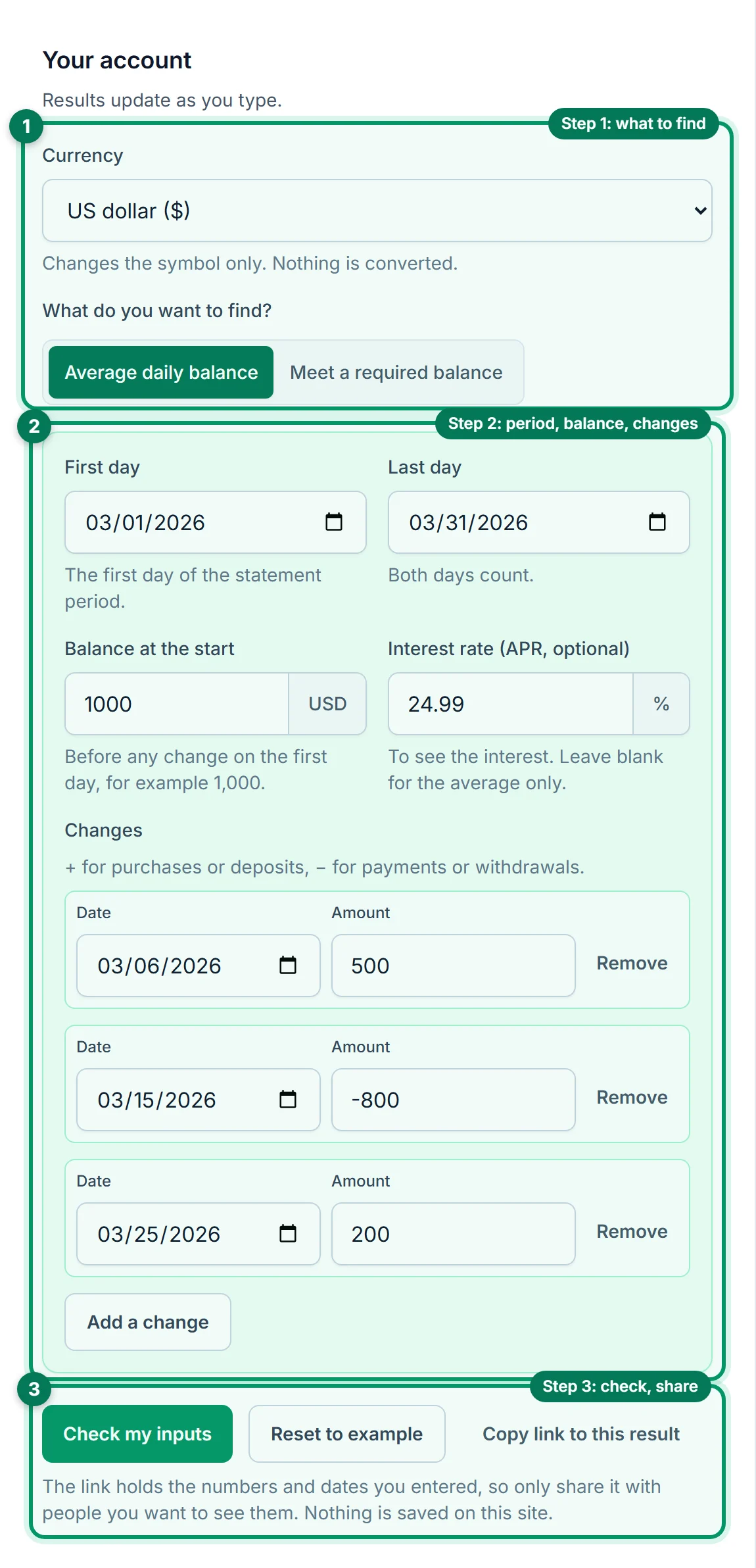
Choose what to find
Pick your Currency. Under What do you want to find?, choose Average daily balance for a statement period, or Meet a required balance for a savings account with a maintaining balance.
Enter the period, the starting balance and each change
Enter the First day, Last day and Balance at the start. Under Changes, give each purchase, deposit, payment or withdrawal its date and amount, with a minus sign for money out or a payment; use Add a change for more. Add an Interest rate to see the interest. For a required balance, enter the requirement, days and balances asked.
Read or share the result
Results update as you type. Check my inputs points to any date outside the period or amount that needs fixing, and Copy link to this result gives a link with your numbers and dates in it.
Your results, explained
Here are the results for the example values: a card in March starting at 1,000, with +500 on 6 March, −800 on 15 March and +200 on 25 March, at 24.99% APR. Each numbered explanation matches a highlighted area in the image.
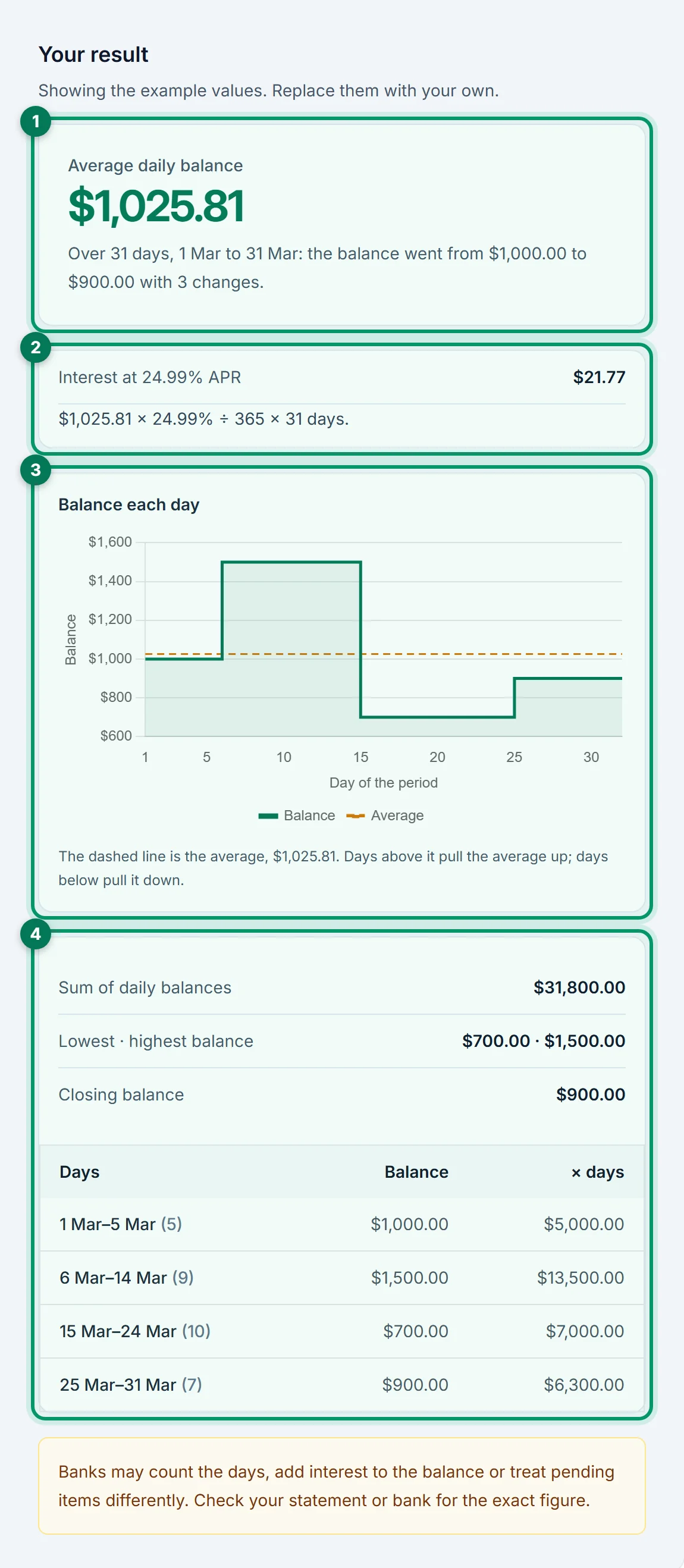
1. Average daily balance: 1,025.81
Each day’s closing balance, added up and divided by the 31 days of March: 31,800 ÷ 31 = 1,025.81. It sits between the lowest balance, 700, and the highest, 1,500, weighted by how long each lasted.
2. Interest at 24.99%: 21.77
A card charges interest on the average daily balance: 1,025.81 × 24.99% ÷ 365 × 31 days = 21.77. Leave Interest rate blank if you only need the average, for example for a savings account.
3. The chart: the balance each day
The green steps are the balance through the month: 1,000, then 1,500 after the purchase, 700 after the payment, and 900 at the end. The dashed line is the average. The longer a balance lasts, the more it counts.
4. The breakdown: each stretch of days
The table lists each stretch with the same balance, its days and balance × days: 5,000 + 13,500 + 7,000 + 6,300 = 31,800. The rows above it give the sum, the lowest and highest balance, and the closing balance.
How each mode works: inputs and results
The calculator has two modes, chosen under What do you want to find? Pick a mode below to see exactly what it needs and what it shows. Both work with Copy link to this result.
Answers: What was my average daily balance over a statement period, and what interest does it produce?
Inputs
| Input | What to enter |
|---|---|
| Currency | The symbol shown on amounts. Nothing is converted. Example: US dollar ($) |
| First day and Last day | The statement or billing period. Both days count. Example: 2026-03-01 to 2026-03-31 |
| Balance at the start | What you owed, or had, at the start of the first day. For a card in credit, use a minus sign. Example: 1,000 |
| Changes (Date and Amount) | Each purchase, deposit, payment or withdrawal: + for money in or purchases, − for money out or payments. Use Add a change for more rows, up to 30. Example: 6 March, 500 |
| Interest rate (APR, optional) | The yearly rate, to see the interest on the average. Leave blank for the average only. Example: 24.99 |
Results
| Result | What it tells you |
|---|---|
| Average daily balance | The main result: the sum of each day’s closing balance divided by the days. The note gives the opening and closing balance. |
| Interest on the average | Only with a rate: average × APR ÷ 365 (or 360) × days. |
| Balance each day (chart) | The balance as steps through the period, with the average as a dashed line. |
| Sum of daily balances, Lowest and highest, Closing balance, and the stretches table | The figures behind the result: each stretch of days with its balance and balance × days. |
The maths
Each change counts from its own date: the balance at the end of each day is used
Average daily balance = (sum of each day’s balance) ÷ days in the period
Interest = average × APR ÷ 365 (or 360) × days
Example
March with 1,000 at the start, +500 on 6 March, −800 on 15 March and +200 on 25 March: 31,800 ÷ 31 = 1,025.81, and 21.77 of interest at 24.99%.
Answers: How much do I need to deposit, or keep, to meet my account’s required average daily balance this month?
Inputs
| Input | What to enter |
|---|---|
| Currency | The symbol shown on amounts. Nothing is converted. Example: Philippine peso (₱) |
| Required average daily balance | The maintaining balance your bank asks for, for example 3,000. Example: 3,000 |
| Days in the month and Days passed | The days in this statement month, and how many have already ended. Example: 30 and 18 |
| Your average so far | Your average daily balance for the days that have passed. Your bank app may show it, or work it out in the other mode. Example: 2,200 |
| Your balance today | What is in the account now. Example: 2,500 |
Results
| Result | What it tells you |
|---|---|
| Deposit today | The main result: how much to add today to reach the requirement by the end of the month, or 0 if you are on track. |
| Balance to keep for the rest of the month | The lowest balance to hold every remaining day. |
| Average if nothing changes, Total needed, Total so far | Where you would end up without a deposit, and the totals behind the result. |
The maths
Total needed = required average × days in the month
Balance to keep = (total needed − average so far × days passed) ÷ days left
Deposit today = balance to keep − balance today (0 if already enough)
Example
A 3,000 requirement, 18 of 30 days passed at an average of 2,200, and 2,500 today: keep 4,200 for the last 12 days, so deposit 1,700 today.
Worked example: a card statement for March
These are the calculator’s example values, and they are illustrative only.
| Days | Balance | × days |
|---|---|---|
| 1–5 Mar (5) | 1,000 | 5,000 |
| 6–14 Mar (9) | 1,500 | 13,500 |
| 15–24 Mar (10) | 700 | 7,000 |
| 25–31 Mar (7) | 900 | 6,300 |
Sum of daily balances = 5,000 + 13,500 + 7,000 + 6,300 = 31,800
Average daily balance = 31,800 ÷ 31 = 1,025.81
Interest at 24.99% = 1,025.81 × 24.99% ÷ 365 × 31 = 21.77
Each change counts from its own date: the purchase on 6 March raises that day’s balance, so the 1,500 lasts 9 days, 6 to 14 March.
Pay earlier, pay less interest
Because the average weights each balance by how long it lasts, the date of a payment matters as much as its size. Move the 800 payment from 15 March to 5 March and the average falls from 1,025.81 to 767.74, cutting the interest at 24.99% from 21.77 to 16.29. The same payment, ten days sooner, saves 5.48 this month.
Keeping a maintaining balance on savings
Many banks, including most in the Philippines, ask a savings account to keep a minimum average daily balance each month. Fall below it and the bank may charge a fee or pay no interest. Because it is an average, a dip for a few days does not fail it, but a big withdrawal lowers every day that follows.
Start November with 5,000, take out 3,000 on the 10th and put back 500 on the 20th. The balance ends at 2,500, but the average is 3,083.33: the full 5,000 stayed in for the first 9 days. With a 3,000 requirement, the money in early in the month is what keeps the account above it.
To plan ahead, choose Meet a required balance. With a 3,000 requirement, 18 of 30 days gone at an average of 2,200 and 2,500 in the account today, you need to keep 4,200 for the last 12 days, so deposit 1,700 today. Doing nothing would leave the month’s average at 2,320.
Before relying on the result
- The wrong sign. For a card, purchases are + and payments −; for savings, deposits are + and withdrawals −.
- Posting dates. Banks count a change from the day it posts, which can be a day or two after you made it.
- Interest added daily. Some cards add each day’s interest to the balance, which raises the average slightly.
- The wrong period. Use the statement’s own first and last day, not the calendar month.
Before you rely on an average:
- Copy the period and the starting balance from your statement.
- Enter every change with its posting date.
- Compare the result with the statement’s figure.
- For a maintaining balance, deposit a little more than the minimum to allow for posting delays.
Sources
- Consumer Financial Protection Bureau: credit card contract definitions Supports the average daily balance as the sum of each day’s balance divided by the days in the billing period, with or without daily compounding.
Sources checked on 21 November 2026.
Frequently asked questions
How is the average daily balance calculated?
Should purchases be plus or minus?
Does paying earlier lower my interest?
Why is my statement’s figure slightly different?
What is a maintaining average daily balance?
Can one big withdrawal break my maintaining balance?
Is anything saved when I copy a link to my result?
Does changing the currency convert my amounts?
Related interest and savings calculators
Keep planning with the tools that answer the next question.
- Daily Interest CalculatorSee what a balance earns or costs each day, compare two rates, or check a statement. Open calculator
- Daily Compound Interest CalculatorSee money grow with interest added every day, the days to a goal, or the daily rate needed. Open calculator
- Daily Savings Goal CalculatorFind how much to save each day, week or payday to reach a goal by a date. Open calculator
- Emergency Fund CalculatorFind how big your emergency fund should be, when you will reach it, or how long it would last. Open calculator
- 52-Week Savings Challenge CalculatorPlan the 52-week challenge, weekly or on paydays, with a printable tracker. Open calculator
- Sinking Fund CalculatorSave ahead for insurance, school fees and other planned costs, fund by fund. Open calculator
- Time to Save CalculatorSee how long a goal takes and the date you reach it, saving each day, week, payday or month. Open calculator
- APY CalculatorConvert an APR to APY for any compounding, or compare two savings accounts. Open calculator
- Simple Interest CalculatorFind simple interest, or the rate, time or principal behind it, and check add-on loans. Open calculator
- CD CalculatorSee what a certificate of deposit is worth at maturity, or what withdrawing early costs. Open calculator
- Credit Card Interest CalculatorSee how long a card takes to pay off, what paying more saves, or one month’s interest. Open calculator
- CAGR CalculatorFind the yearly growth rate between two values, or project one forward. Open calculator
- Dividend Reinvestment CalculatorSee how income grows when every payout is reinvested. Open calculator