
What is the Simple Interest Calculator?
The Simple Interest Calculator works out interest charged only on the original amount: principal × rate × time. Enter any three of principal, rate, time and interest and it finds the fourth, with monthly rates, days or dates, and an add-on loan check that shows the real APR.
5% for 3 years on 10,000 is 1,500, and never more
Lend or deposit 10,000 at 5% simple interest for 3 years and it earns 500 a year, every year: 1,500 in total. The interest never earns interest of its own. The same 5% compounded monthly would earn 1,614.72, because each month’s interest joins the balance.
Simple interest is common on short-term loans, some bonds and school problems. Many personal loans quote a flat add-on rate, which looks low but costs far more than it says, and the calculator shows how much. For accounts that compound, use the APY Calculator or the Daily Interest Calculator.
How to use the calculator
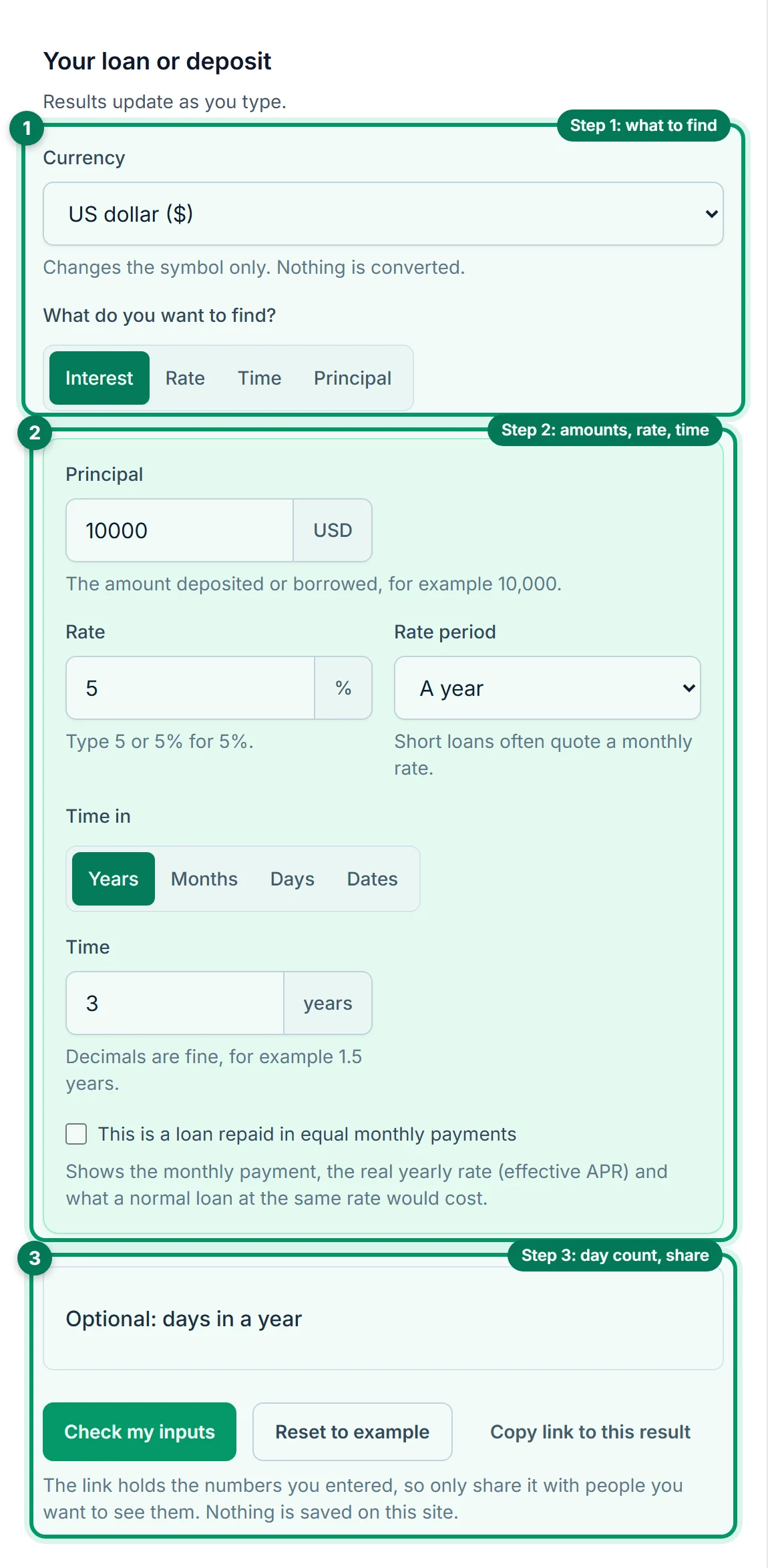
Choose what to find
Pick your Currency. Under What do you want to find?, choose Interest, Rate, Time or Principal. The form asks only for the other three.
Enter the amounts, rate and time
Enter the Principal or Interest, and the Rate, typing 5 for 5%, with its Rate period: a year or a month. Under Time in, choose Years, Months or Days and enter the Time, or choose Dates. For a loan with equal monthly payments, tick This is a loan repaid in equal monthly payments.
Set the day count, then read or share
Open Optional: days in a year to use a 360-day year when the time is in days. Results update as you type, and Copy link to this result gives a link with your numbers in it.
Your results, explained
Here are the results for the example values: 10,000 at 5% a year for 3 years, finding the interest. Each numbered explanation matches a highlighted area in the image.
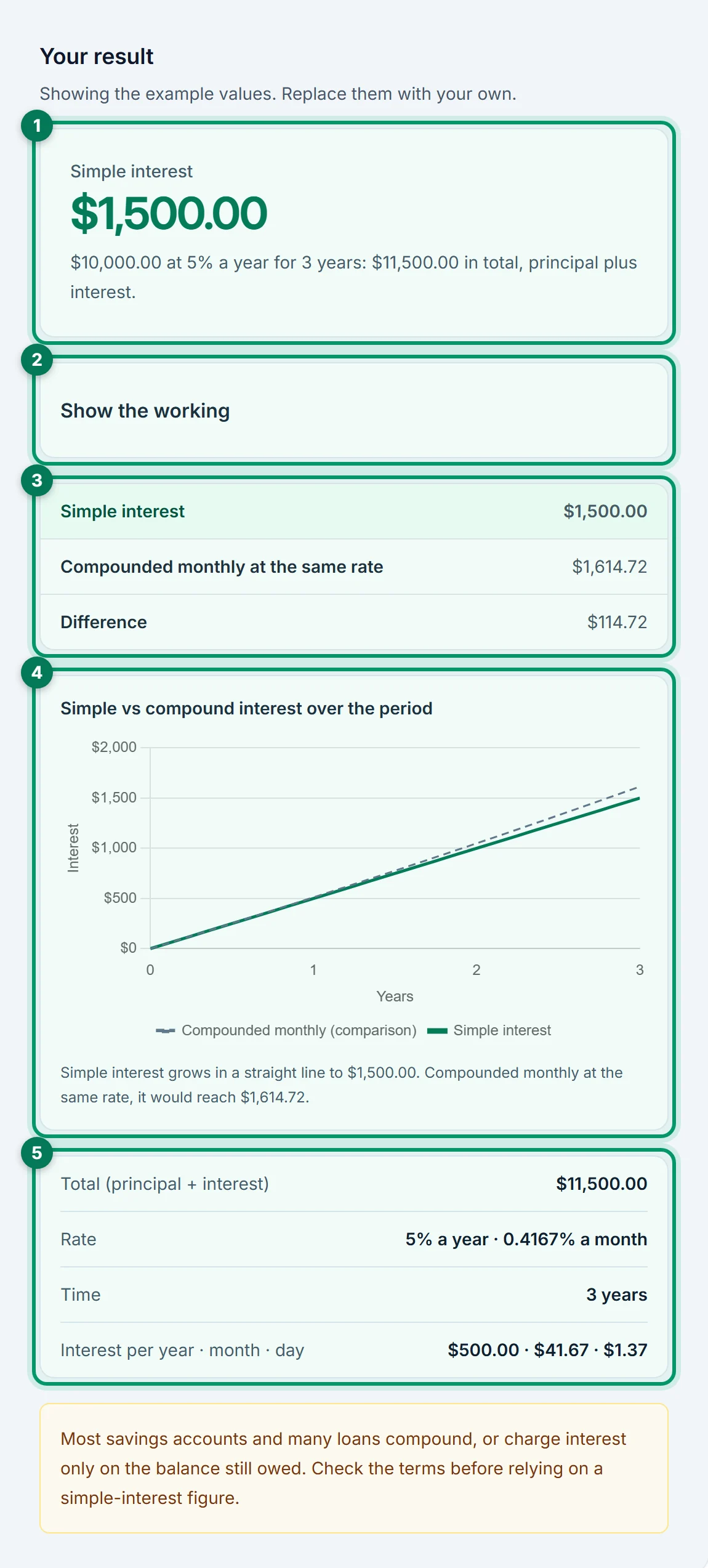
1. Simple interest: 1,500.00
Principal × rate × time: 10,000 × 0.05 × 3 = 1,500. The note adds it to the principal for the total you get back or repay: 11,500.00. Simple interest is always worked out on the original 10,000, never on interest already earned.
2. Show the working
Open it for the steps with your own numbers: Rate: 5% = 0.05, then 10,000 × 0.05 × 3 = 1,500, then the total of 11,500. In the Rate, Time and Principal modes it shows the rearranged formula, so you can copy the method or check homework.
3. Simple vs compound: 1,500.00 vs 1,614.72
The same 5% compounded monthly would add interest to the balance each month and earn interest on it, reaching 1,614.72 over the 3 years: 114.72 more. Most savings accounts compound, so use this row to see what simple interest leaves out.
4. The chart: a straight line
Simple interest grows by the same 500 every year, so it is a straight line. The dashed compound line curves upward and pulls away the longer the money stays in. Over short periods the two are almost the same.
5. Total, rate and interest per year, month and day
The breakdown gives the total of 11,500.00, the rate as 5% a year or 0.4167% a month, and the interest per year (500.00), per month (41.67) and per day (1.37 on a 365-day year).
How each mode works: inputs and results
The calculator has four modes, chosen under What do you want to find? Each one asks for the other three values. Pick a mode below to see exactly what it needs and what it shows. Every mode works with Copy link to this result.
Answers: How much simple interest does a deposit earn or a loan cost, and what is the total?
Inputs
| Input | What to enter |
|---|---|
| Currency | The symbol shown on amounts. Nothing is converted. Example: US dollar ($) |
| Principal | The amount deposited or borrowed, for example 10,000. Example: 10,000 |
| Rate and Rate period | The interest rate, then a year or a month. Type 5 for 5%; a monthly rate is common on short loans. Example: 5, a year |
| Time in | Years, Months or Days, then the Time; or Dates, then a Start date and End date (each night counts as one day). Example: Years, 3 |
| Optional: days in a year | Days in a year: 365 (exact interest) or 360 (ordinary interest). Used whenever the time is in days. Example: 365 |
| This is a loan repaid in equal monthly payments | Optional. Tick it for a loan quoted at an add-on (flat) rate and repaid in equal monthly payments; the time must be whole months or years. Example: Ticked, 24 months |
Results
| Result | What it tells you |
|---|---|
| Simple interest | The main result: principal × rate × time. The note gives the total, principal plus interest. |
| Monthly payment and effective APR | Only with equal monthly payments: (principal + interest) ÷ months, and the yearly rate you really pay on the balance you still owe. |
| Same rate on the reducing balance and Extra interest with the add-on | Only with equal monthly payments: what a normal loan at the same rate would cost each month and in total, and how much more the add-on charges. |
| Simple vs compound interest | The same rate compounded monthly over the same time, and how much more it would be. |
| Simple vs compound interest over the period (chart) | Both totals over time: a straight line for simple, a curve for compound. |
| Total, rate, time and interest per year, month and day | The figures behind the result, for checking it by hand. |
| Show the working | The steps from your inputs to the result, with your own numbers. |
The maths
Interest = principal × yearly rate × time in years
A monthly rate × 12 = the yearly rate; days ÷ 365 (or 360) = years
Monthly payment = (principal + interest) ÷ months; effective APR = 12 × the monthly rate that repays the principal with those payments
Example
10,000 at 5% a year for 3 years earns 1,500.00, for 11,500.00 in total. As an add-on loan, 100,000 at 12% a year over 24 months costs 5,166.67 a month, an effective APR of 21.57%; on the reducing balance it would be 4,707.35 a month.
Answers: What simple interest rate turns a principal into a known amount of interest over a set time?
Inputs
| Input | What to enter |
|---|---|
| Currency | The symbol shown on amounts. Nothing is converted. Example: US dollar ($) |
| Principal | The amount deposited or borrowed, for example 10,000. Example: 10,000 |
| Interest | The interest earned or charged over the whole time, for example 1,500. Example: 1,500 |
| Time in | Years, Months or Days, then the Time; or Dates, then a Start date and End date (each night counts as one day). Example: Years, 3 |
| Optional: days in a year | Days in a year: 365 (exact interest) or 360 (ordinary interest). Used whenever the time is in days. Example: 365 |
Results
| Result | What it tells you |
|---|---|
| Rate | The main result: the yearly rate, with the monthly rate in the note. |
| Simple vs compound interest, chart and breakdown | The same comparison, chart and figures as in the Interest mode, at the rate found. |
| Show the working | The rearranged formula with your own numbers. |
The maths
Rate = interest ÷ (principal × time in years)
Monthly rate = yearly rate ÷ 12
Example
1,500 of interest on 10,000 over 3 years means a rate of 5% a year, or 0.4167% a month.
Answers: How long does a principal take to earn a set amount of simple interest?
Inputs
| Input | What to enter |
|---|---|
| Currency | The symbol shown on amounts. Nothing is converted. Example: US dollar ($) |
| Principal | The amount deposited or borrowed, for example 10,000. Example: 10,000 |
| Interest | The interest earned or charged over the whole time, for example 1,500. Example: 1,500 |
| Rate and Rate period | The interest rate, then a year or a month. Type 5 for 5%; a monthly rate is common on short loans. Example: 5, a year |
| Optional: days in a year | Days in a year, 365 or 360, for the time shown in days. Example: 365 |
Results
| Result | What it tells you |
|---|---|
| Time | The main result in years and months. The note gives the exact years and the days. |
| Simple vs compound interest, chart and breakdown | The same comparison, chart and figures as in the Interest mode, over the time found. |
| Show the working | The rearranged formula with your own numbers. |
The maths
Time in years = interest ÷ (principal × yearly rate)
Days = years × 365 (or 360)
Example
10,000 at 6% a year takes 1 year 8 months to earn 1,000: 1.6667 years, or about 608.3333 days.
Answers: How much do I need to deposit to earn a set amount of simple interest?
Inputs
| Input | What to enter |
|---|---|
| Currency | The symbol shown on amounts. Nothing is converted. Example: US dollar ($) |
| Interest | The interest earned or charged over the whole time, for example 1,500. Example: 1,500 |
| Rate and Rate period | The interest rate, then a year or a month. Type 5 for 5%; a monthly rate is common on short loans. Example: 5, a year |
| Time in | Years, Months or Days, then the Time; or Dates, then a Start date and End date (each night counts as one day). Example: Years, 3 |
| Optional: days in a year | Days in a year: 365 (exact interest) or 360 (ordinary interest). Used whenever the time is in days. Example: 365 |
Results
| Result | What it tells you |
|---|---|
| Principal needed | The main result: the amount that earns your interest at this rate and time. |
| Simple vs compound interest, chart and breakdown | The same comparison, chart and figures as in the Interest mode, for the principal found. |
| Show the working | The rearranged formula with your own numbers. |
The maths
Principal = interest ÷ (yearly rate × time in years)
Example
To earn 1,500 at 5% a year over 3 years, you need 10,000.00.
Worked example: 10,000 at 5% for 3 years
These are the calculator’s example values, and they are illustrative only.
Interest = principal × rate × time
Interest = 10,000 × 0.05 × 3 = 1,500
Total = 10,000 + 1,500 = 11,500
Each year adds the same 500, because the rate always applies to the original 10,000. That is 41.67 a month, or 1.37 a day on a 365-day year. Open Show the working, just under the result, to see these steps with your own numbers, in any mode.
Solving for the rate, time or principal
The formula works in any direction. Choose the mode for the value you don’t know, and the calculator rearranges it for you.
Rate: 1,500 ÷ (10,000 × 3) = 0.05, so 5% a year
Time: 1,000 ÷ (10,000 × 0.06) = 1.6667 years, about 1 year 8 months
Principal: 1,500 ÷ (0.05 × 3) = 10,000
In the Time mode, the result also shows the time in days: 1.6667 years is about 608.3333 days on a 365-day year.
365 or 360 days: exact and ordinary interest
When the time is in days, it has to be turned into years. Exact interest divides by 365. Ordinary interest, also called the banker’s rule, divides by 360, which gives a little more.
| Method | Calculation | Interest |
|---|---|---|
| Exact (365) | 5,000 × 0.06 × 90 ÷ 365 | 73.97 |
| Ordinary (360) | 5,000 × 0.06 × 90 ÷ 360 | 75.00 |
Choose the one your agreement or textbook uses under Days in a year. With Dates, each night between them counts as one day: 15 January to 15 July 2026 is 181 days.
Add-on loans: the real rate is higher
Some lenders work out simple interest on the full loan for the whole term, add it on, and split the total into equal monthly payments. The quoted rate looks low, but you keep paying interest on money you have already paid back.
Take 100,000 at a 12% add-on rate over 24 months. Tick This is a loan repaid in equal monthly payments:
Interest = 100,000 × 0.12 × 2 = 24,000
Monthly payment = (100,000 + 24,000) ÷ 24 = 5,166.67
Effective APR = 21.57% a year
The effective APR is the rate that, charged on the balance you still owe each month, gives exactly those 24 payments. It is almost double the quoted 12%. Monthly add-on rates are steeper still: 20,000 at 2% a month over 6 months costs 3,733.33 a month, an effective APR of 40.05%. Compare loans by their effective APR, not the add-on rate.
The payments card also shows the same 12% charged the usual way, on the reducing balance: 4,707.35 a month and 12,976.33 of interest in total. The add-on charges 11,023.67 more for the same loan, which is the figure to weigh when one lender quotes an add-on rate and another quotes a normal loan rate.
Before relying on the result
- A compounding account treated as simple. Savings accounts usually compound, so simple interest understates them.
- The wrong rate period. A rate of 2% a month is 24% a year; check whether yours is quoted a month or a year.
- An add-on rate taken at face value. Tick This is a loan repaid in equal monthly payments to see the effective APR.
- Fees left out. Processing fees and other charges raise the real cost of a loan further.
Before you sign or compare:
- Ask whether interest is simple, add-on or charged on the reducing balance.
- Check whether the rate is a month or a year.
- Compare loans by effective APR.
- Add any fees to the cost.
Frequently asked questions
What is the simple interest formula?
How is simple interest different from compound interest?
How do I enter a monthly interest rate?
What are exact and ordinary interest?
What is an add-on interest rate?
What is the difference between add-on and reducing-balance interest?
Can I see the steps of the calculation?
How are days counted between two dates?
Is anything saved when I copy a link to my result?
Does changing the currency convert my amounts?
Related interest and savings calculators
Keep planning with the tools that answer the next question.
- Daily Interest CalculatorSee what a balance earns or costs each day, compare two rates, or check a statement. Open calculator
- Daily Compound Interest CalculatorSee money grow with interest added every day, the days to a goal, or the daily rate needed. Open calculator
- Daily Savings Goal CalculatorFind how much to save each day, week or payday to reach a goal by a date. Open calculator
- Emergency Fund CalculatorFind how big your emergency fund should be, when you will reach it, or how long it would last. Open calculator
- 52-Week Savings Challenge CalculatorPlan the 52-week challenge, weekly or on paydays, with a printable tracker. Open calculator
- Sinking Fund CalculatorSave ahead for insurance, school fees and other planned costs, fund by fund. Open calculator
- Time to Save CalculatorSee how long a goal takes and the date you reach it, saving each day, week, payday or month. Open calculator
- APY CalculatorConvert an APR to APY for any compounding, or compare two savings accounts. Open calculator
- CD CalculatorSee what a certificate of deposit is worth at maturity, or what withdrawing early costs. Open calculator
- Credit Card Interest CalculatorSee how long a card takes to pay off, what paying more saves, or one month’s interest. Open calculator
- Average Daily Balance CalculatorAverage a balance over a statement period, or see what to deposit to meet a maintaining balance. Open calculator
- CAGR CalculatorFind the yearly growth rate between two values, or project one forward. Open calculator
- Dividend Reinvestment CalculatorSee how income grows when every payout is reinvested. Open calculator