
What is the Sinking Fund Calculator?
The Sinking Fund Calculator splits each cost you know is coming into small, regular savings that finish on its due date. List your funds with their amounts and dates; it shows what to set aside each month, payday or week, per fund and in total, or turns all your yearly bills into one steady amount.
The bills that arrive once a year are the ones that hurt
Car insurance, school fees, a registration renewal, holiday gifts: none of them is a surprise, yet each can take a whole month’s spare money when it lands. A sinking fund spreads each one out. Instead of 1,200 in June, the insurance becomes 166.67 a month from January, and with all three example funds, one steady 250.00 a month pays every bill on time.
For costs you cannot predict, build an emergency fund; for a single goal by a date, use the Daily Savings Goal Calculator.
How to use the calculator
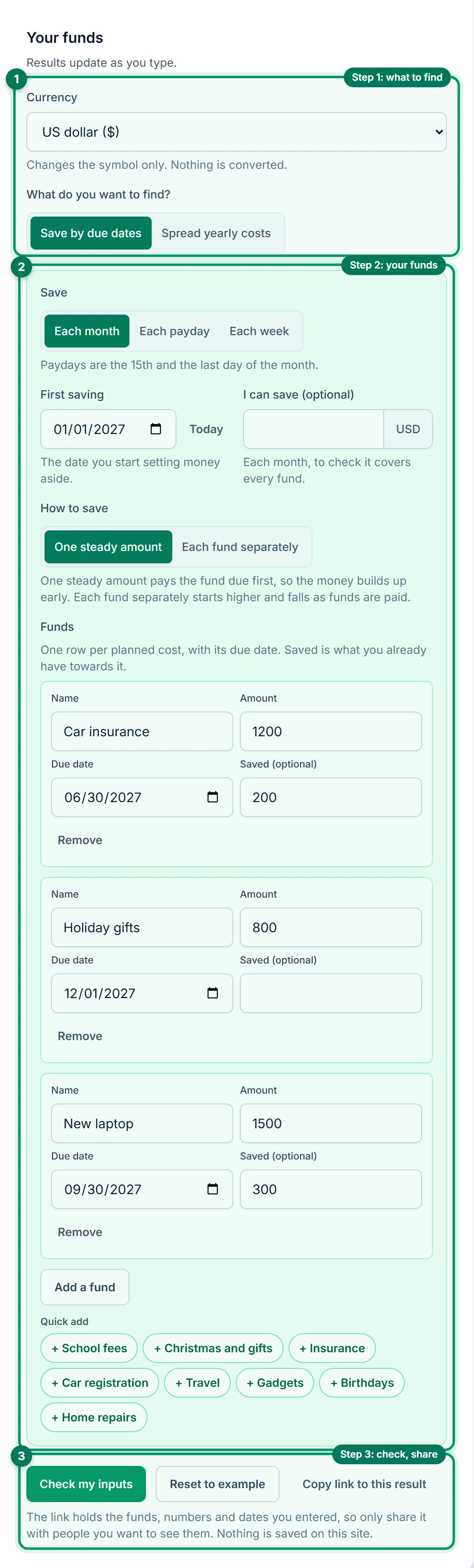
Choose what to find
Pick your Currency, then choose Save by due dates for costs with a date, such as school fees in June, or Spread yearly costs for bills that come back every year.
Set up your funds
Work through the green area from top to bottom:
- Save: match how you are paid. Paydays are the 15th and the last day of the month.
- First saving: the day of the first transfer; Today starts now.
- I can save (optional): your budget each time, to check it covers every fund.
- How to save: One steady amount keeps the same transfer all year; Each fund separately starts higher and drops as funds are paid.
- Funds: each cost’s Name, Amount, Due date (when the bill is due) and what is Saved. Quick add fills in common names, and doubles as a checklist of costs people forget.
Read, share or print
Results update as you type. Check my inputs jumps to anything that needs fixing, such as a due date before the first saving.
Copy link to this result keeps your list to reopen or share. Under Keep to the plan, print a tracker with a box for every saving, or add a repeating reminder. When a bill changes, edit its row and print a fresh tracker.
Your results, explained
Here are the results for the example: car insurance, holiday gifts and a new laptop in 2027, saving monthly from 1 January. Each numbered explanation matches a highlighted area in the image.
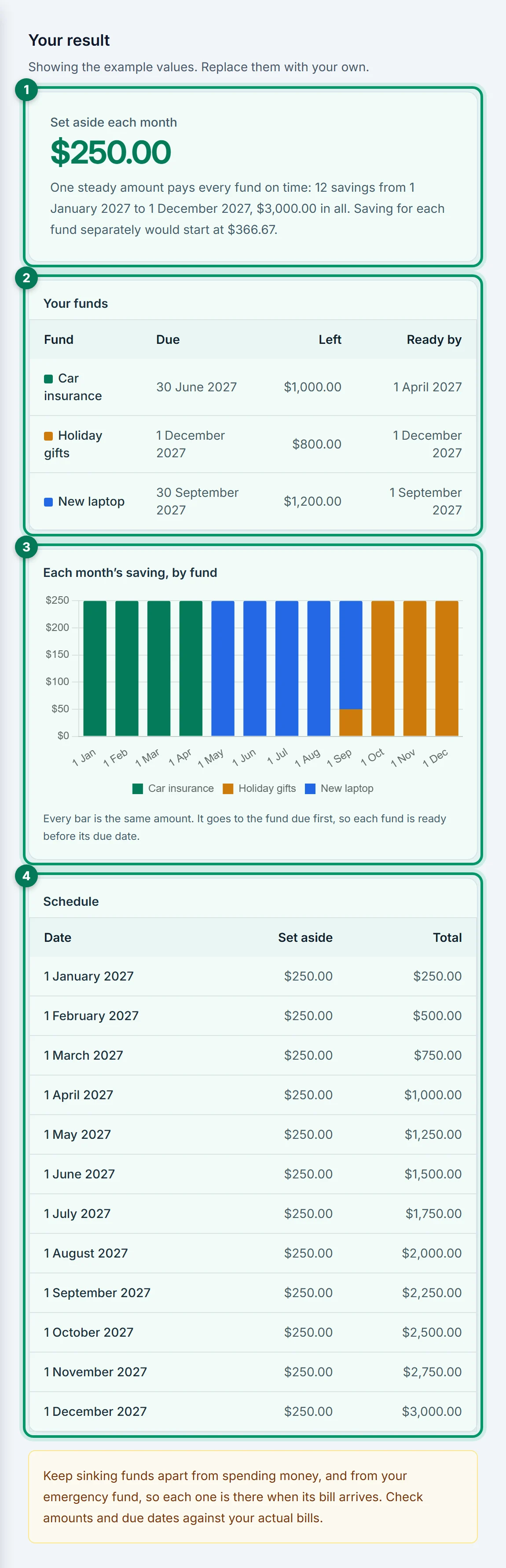
1. Set aside each month: 250.00
One steady amount pays all three funds on time. It is the largest of 1,000 needed by 30 June over 6 months (166.67), 2,200 by 30 September over 9 (244.44) and 3,000 by 1 December over 12 (250.00). Saving each fund separately would start at 366.67.
A big cost due early can need more per month than the full year does, so the calculator checks every due date and takes the highest, rounded up to the cent.
2. Your funds
Each fund’s due date, what is left after what you have saved, and the date it is ready. The steady amount goes to the fund due first, so the insurance is ready by 1 April, well before 30 June.
Left is the amount less what you have saved: 1,200 less 200 is 1,000 for the insurance. Each fund separately shows each fund’s own amount instead, such as 166.67 × 6.
3. The chart: each month’s saving, by fund
Every bar is the same 250.00, coloured by the fund it goes to: the insurance first, then the laptop, then the gifts. Choose Each fund separately to see the step-down plan instead.
Where a bar has two colours, one fund was finished and the rest of that saving moved on. In September, 200 completes the laptop’s 1,200 and the other 50 starts the gifts, which then need 250 a month in October, November and December.
4. The schedule
Every saving date with the amount and the running total, reaching the 3,000 still to save on 1 December.
The running total is what your sinking fund account should hold after each saving, so you can compare it with your balance.
Check it against your budget
With 200 a month under I can save, the laptop is 400 short on 30 September: 9 savings of 200 make 1,800, but 2,200 is needed by then. Save 250 a month, or move the laptop later.
How each mode works: inputs and results
The calculator has two modes, chosen under What do you want to find? Pick a mode below to see exactly what it needs and what it shows. Both work with Copy link to this result.
Answers: How much should I set aside for each planned cost so it is ready when it is due?
Inputs
| Input | What to enter |
|---|---|
| Save and First saving | How often you save (each month, each payday or each week) and the date of the first saving. Paydays are the 15th and the last day of the month. Example: Each month from 2027-01-01 |
| I can save (optional) | What you can set aside each time, to check it covers every fund. Example: Blank, or 200 |
| How to save | One steady amount, paid to the fund due first, or Each fund separately, which starts higher and falls as funds are paid. Example: One steady amount |
| Funds: Name, Amount, Due date, Saved | One row per cost. Saved is what you already have towards it. Use Add a fund, or a Quick add name, for up to 12. Example: Car insurance, 1,200, 2027-06-30, 200 |
Results
| Result | What it tells you |
|---|---|
| Set aside each … | The main result: the one steady amount that pays every fund on time, or, for Each fund separately, the first total and how it falls. |
| I can save check | Whether your budget covers every fund, or which fund falls short, when and by how much. |
| Your funds | Each fund’s due date, what is left to save, and the date it is ready (or the amount per saving, for Each fund separately). |
| Chart and schedule | Each saving date split by fund, and the amount and running total. |
The maths
Steady amount = the largest of (money still needed by each due date) ÷ (saving dates up to that due date), rounded up
Each fund separately: per saving = (amount − saved) ÷ the saving dates up to its due date
Example
Car insurance 1,200 due 30 June with 200 saved, gifts 800 due 1 December, a laptop 1,500 due 30 September with 300 saved: one steady 250.00 a month. Separately, 366.67 a month at first, then 200.00 from July and 66.67 from October.
Answers: What one steady amount covers all my yearly bills?
Inputs
| Input | What to enter |
|---|---|
| Save and First saving | How often you save and when you start. Example: Each month from 2027-01-01 |
| Funds: Name and Cost a year | Every bill you pay once or a few times a year. Example: Car insurance, 1,200 |
Results
| Result | What it tells you |
|---|---|
| Set aside each … | The main result: the yearly total ÷ 12, 24 or 52, with the same amount for the other periods. |
| Your funds and schedule | Each bill’s share and amount per saving, and every date for a year. |
The maths
Per month = yearly total ÷ 12; per payday ÷ 24; per week ÷ 52
Example
Five yearly bills come to 3,140: 261.67 a month, 130.83 a payday or 60.38 a week.
Worked example: school fees, insurance and Christmas on paydays
A family in the Philippines plans three costs for 2027 and saves on paydays, the 15th and the last day of each month, from 15 January. These figures are illustrative.
| Fund | Due | Paydays | Per payday |
|---|---|---|---|
| School fees ₱22,000 | 15 June | 11 | ₱2,000 |
| Car insurance ₱18,000 | 30 September | 18 | ₱1,000 |
| Christmas ₱15,000 | 15 December | 23 | ₱652.17 |
Until June, each payday needs ₱3,652.17. Once the school fees are paid it falls to ₱1,652.17, and after September to ₱652.17. The bigger amounts come first, so part of last December’s 13th-month pay can cover the early paydays. Or choose One steady amount: ₱2,391.31 each payday pays all three funds on time, with the school fees ready by 31 May.
Tips for sinking funds
- List every yearly bill. Go through last year’s bank statements for anything that came once or twice.
- Name each fund. Separate savings pockets, or a list like this one, show what each fund holds.
- Start early. The further away the due date, the smaller each saving.
- Keep them apart from your emergency fund. A planned bill should never use money meant for surprises.
Frequently asked questions
What is a sinking fund?
How is a sinking fund different from an emergency fund?
How do I work out how much to save?
Should I save one steady amount or each fund separately?
How do I check whether I can afford my funds?
Can I save on paydays instead of monthly?
Should I keep one account or several?
What if I only want one steady amount for all my yearly bills?
Is anything saved when I copy a link to my result?
Does changing the currency convert my amounts?
Related interest and savings calculators
Keep planning with the tools that answer the next question.
- Daily Interest CalculatorSee what a balance earns or costs each day, compare two rates, or check a statement. Open calculator
- Daily Compound Interest CalculatorSee money grow with interest added every day, the days to a goal, or the daily rate needed. Open calculator
- Daily Savings Goal CalculatorFind how much to save each day, week or payday to reach a goal by a date. Open calculator
- Emergency Fund CalculatorFind how big your emergency fund should be, when you will reach it, or how long it would last. Open calculator
- 52-Week Savings Challenge CalculatorPlan the 52-week challenge, weekly or on paydays, with a printable tracker. Open calculator
- Time to Save CalculatorSee how long a goal takes and the date you reach it, saving each day, week, payday or month. Open calculator
- APY CalculatorConvert an APR to APY for any compounding, or compare two savings accounts. Open calculator
- Simple Interest CalculatorFind simple interest, or the rate, time or principal behind it, and check add-on loans. Open calculator
- CD CalculatorSee what a certificate of deposit is worth at maturity, or what withdrawing early costs. Open calculator
- Credit Card Interest CalculatorSee how long a card takes to pay off, what paying more saves, or one month’s interest. Open calculator
- Average Daily Balance CalculatorAverage a balance over a statement period, or see what to deposit to meet a maintaining balance. Open calculator
- CAGR CalculatorFind the yearly growth rate between two values, or project one forward. Open calculator
- Dividend Reinvestment CalculatorSee how income grows when every payout is reinvested. Open calculator