
What is the CD Calculator?
The CD Calculator works out what a certificate of deposit, also called a time deposit, is worth when it matures, from your deposit, its APY or APR and its term in months. It can compare the CD with a savings account, and show what you would get back if you withdrew early and paid the penalty.
10,000 becomes 10,450, if you leave it alone
Put 10,000 in a 12-month CD at 4.5% APY and it is worth 10,450.00 when it matures. The catch is the lock-in. Take the money out after 6 months with a 3-month penalty and you get back 10,110.02, giving up 339.98 of the interest you would have had by waiting.
The calculator shows both sides, so you can choose a term you can actually wait out. It does not know your bank’s exact penalty rules or what rate a CD will renew at, so check those in the terms. For a savings account without a lock-in, use the APY Calculator.
How to use the calculator
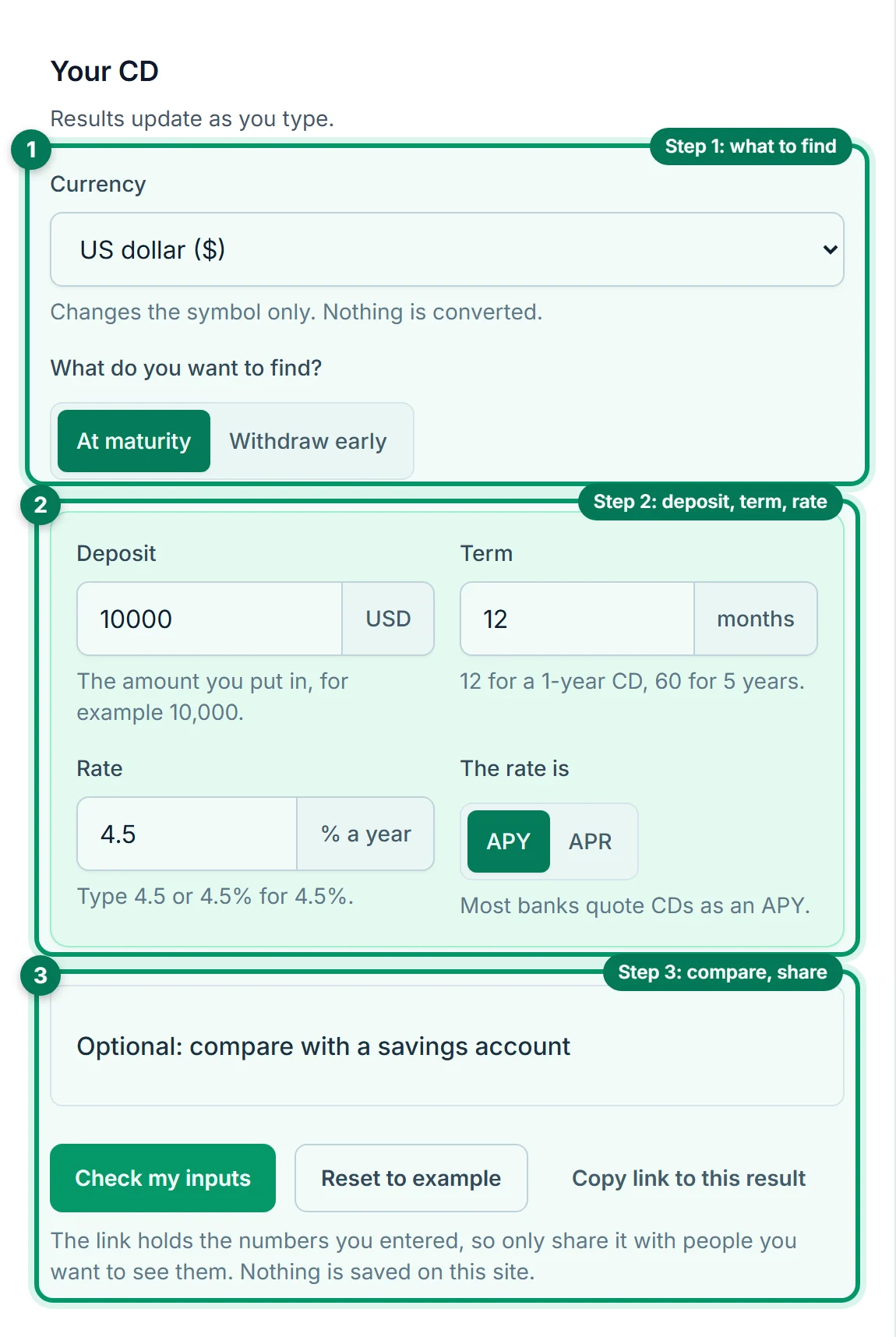
Choose what to find
Pick your Currency. Under What do you want to find?, choose At maturity for the CD’s final value or Withdraw early to see what you would get back before then.
Enter the deposit, term and rate
Enter the Deposit, the Term in months and the Rate, then choose APY or APR under The rate is, as the bank quotes it. To withdraw early, also enter Withdraw after and the Penalty in months or days of interest.
Compare, then read or share
Open Optional: compare with a savings account to set the CD beside a savings rate. Results update as you type, and Copy link to this result gives a link with your numbers in it.
Your results, explained
Here are the results for the example values: 10,000 in a 12-month CD at 4.5% APY, at maturity. Each numbered explanation matches a highlighted area in the image.
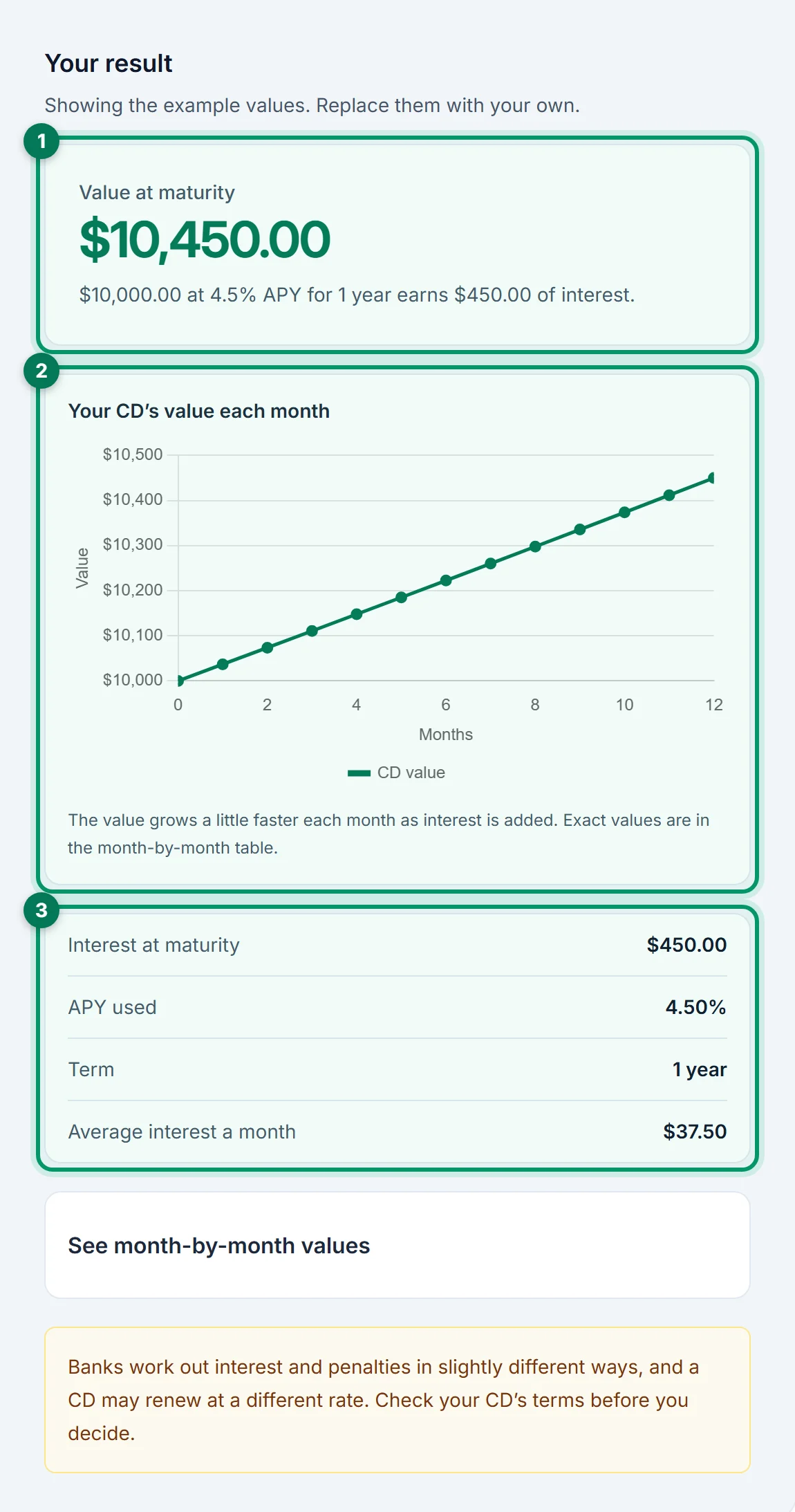
1. Value at maturity: 10,450.00
What the CD is worth when its 12 months are up: 10,000 × 1.045 = 10,450. Because the rate is an APY, it already includes compounding, so one year at 4.5% APY earns exactly 450.00.
2. The chart: value each month
The line shows what the CD is worth at each month end, from 10,000 to 10,450. Add a savings rate under Optional: compare with a savings account to draw it beside the CD, or switch to Withdraw early to see what you would get back each month.
3. Interest, APY and average per month
The breakdown repeats the 450.00 of interest, the 4.50% APY used for every figure, the term, and the average interest a month: 450 ÷ 12 = 37.50. The month-by-month table below it gives every month’s value.
How each mode works: inputs and results
The calculator has two modes, chosen under What do you want to find? Pick a mode below to see exactly what it needs and what it shows. Both work with Copy link to this result.
Answers: What will my CD be worth when it matures, and does it beat a savings account?
Inputs
| Input | What to enter |
|---|---|
| Currency | The symbol shown on amounts. Nothing is converted. Example: US dollar ($) |
| Deposit | The amount you put in the CD, for example 10,000. Example: 10,000 |
| Rate and The rate is | The CD’s rate, then APY or APR as the bank quotes it. For an APR, also choose how often it Compounds. Example: 4.5, APY |
| Term | The CD’s length in whole months, from 1 to 120: 12 for a 1-year CD, 60 for 5 years. Example: 12 |
| Optional: compare with a savings account | A savings account’s APY, to draw it beside the CD over the same term. Leave it blank to skip. Example: 4 |
Results
| Result | What it tells you |
|---|---|
| Value at maturity | The main result: what the CD is worth at the end of the term. The note gives the interest earned. |
| CD vs savings account | Only with a savings rate: both values at maturity and how much more the CD (or the savings account) earns. |
| Your CD’s value each month (chart) | The value at each month end, with the savings account beside it when you enter one. |
| Interest earned, APY, Term, Average a month | The figures behind the result, then the month-by-month table. |
The maths
From an APR: APY = (1 + APR ÷ n)^n − 1, where n is 365, 12, 4 or 1
Value after m months = deposit × (1 + APY)^(m ÷ 12)
Interest = value at maturity − deposit
Example
10,000 at 4.5% APY for 12 months is worth 10,450.00 at maturity, 50.00 more than a savings account at 4% APY.
Answers: What do I get back if I take the money out before the CD matures?
Inputs
| Input | What to enter |
|---|---|
| Currency | The symbol shown on amounts. Nothing is converted. Example: US dollar ($) |
| Deposit | The amount you put in the CD, for example 10,000. Example: 10,000 |
| Rate and The rate is | The CD’s rate, then APY or APR as the bank quotes it. For an APR, also choose how often it Compounds. Example: 4.5, APY |
| Term | The CD’s length in whole months, from 1 to 120: 12 for a 1-year CD, 60 for 5 years. Example: 12 |
| Withdraw after | The whole month you would take the money out, before the term ends. Example: 6 |
| Penalty and Penalty in | The early-withdrawal penalty from your CD terms, as months or days of interest. Example: 3, months |
Results
| Result | What it tells you |
|---|---|
| You would get back | The main result: the deposit plus the interest so far, minus the penalty. The note says how much waiting would add, or how much of your deposit you would lose. |
| Interest earned so far, Penalty, Gain or loss on your deposit, Given up by not waiting | The parts of the payout, and what withdrawing costs compared with waiting. |
| Interest covers the penalty from | The first month when the interest earned is at least the penalty, so you get back more than you put in. |
| What you would get back each month (chart) | The CD’s value and the early-withdrawal payout for every month, with your deposit as a line. |
The maths
Interest so far = deposit × ((1 + APY)^(months ÷ 12) − 1)
Penalty = deposit × the CD’s rate × penalty time in years (months ÷ 12 or days ÷ 365)
You get back = deposit + interest so far − penalty
Example
Withdrawing after 6 months with a 3-month penalty: 10,000 + 222.52 − 112.50 = 10,110.02, or 339.98 less than waiting. The interest covers the penalty from month 4.
Worked example: 10,000 for 12 months at 4.5% APY
These are the calculator’s example values, and they are illustrative only.
Value = deposit × (1 + APY)months ÷ 12
Value = 10,000 × 1.04512 ÷ 12 = 10,450.00
Interest = 10,450.00 − 10,000 = 450.00
For an 18-month CD at the same APY, the value is 10,000 × 1.0451.5 = 10,682.54. If your bank quotes an APR instead, choose APR and its compounding: 4.4% APR compounded daily is a 4.50% APY.
What withdrawing early costs
Most CDs charge a penalty if you take the money out before they mature, stated as days or months of interest. The calculator takes it as simple interest on the deposit at the CD’s rate: 3 months at 4.5% on 10,000 is 10,000 × 4.5% × 3 ÷ 12 = 112.50.
| Withdraw after | Interest so far | Penalty | You get back |
|---|---|---|---|
| 2 months | 73.63 | 112.50 | 9,961.13 |
| 4 months | 147.80 | 112.50 | 10,035.30 |
| 6 months | 222.52 | 112.50 | 10,110.02 |
Withdraw after 2 months and you get back less than you put in: the interest has not yet covered the penalty. From month 4 it has, which the result shows as Interest covers the penalty from. A longer penalty pushes that point later. With 180 days of interest, withdrawing after 2 months returns 9,851.71, a loss of 148.29, and the interest only covers the penalty from month 6.
CD or savings account?
A CD usually pays more because you agree to leave the money alone. Open Optional: compare with a savings account and enter a savings APY: at 4% against the CD’s 4.5%, the CD earns 50.00 more on 10,000 over the year.
Weigh that against two things the calculator cannot know. A savings account lets you take money out any time, and its rate can rise or fall during the year. If you may need the money before the CD matures, the early withdrawal section above shows what that would cost.
Before relying on the result
- An APR entered as an APY. Check the wording in the CD offer and choose the matching type.
- A different penalty method. Some banks charge the penalty on the amount withdrawn, or compound it; check your terms.
- Automatic renewal. At maturity many CDs renew at the rate of the day, which may be lower.
- Taxes. Interest is usually taxable, which the calculator does not include.
Before you open a CD:
- Choose a term you can wait out.
- Read the early-withdrawal penalty and enter it in Withdraw early.
- Compare the CD with a savings account at today’s rate.
- Check what happens at maturity.
Frequently asked questions
Is a CD the same as a time deposit?
How is CD interest calculated?
Should I enter the APY or the APR?
What is an early-withdrawal penalty?
Can I lose money on a CD?
Is a CD better than a savings account?
What happens when my CD matures?
Is anything saved when I copy a link to my result?
Does changing the currency convert my amounts?
Related interest and savings calculators
Keep planning with the tools that answer the next question.
- Daily Interest CalculatorSee what a balance earns or costs each day, compare two rates, or check a statement. Open calculator
- Daily Compound Interest CalculatorSee money grow with interest added every day, the days to a goal, or the daily rate needed. Open calculator
- Daily Savings Goal CalculatorFind how much to save each day, week or payday to reach a goal by a date. Open calculator
- Emergency Fund CalculatorFind how big your emergency fund should be, when you will reach it, or how long it would last. Open calculator
- 52-Week Savings Challenge CalculatorPlan the 52-week challenge, weekly or on paydays, with a printable tracker. Open calculator
- Sinking Fund CalculatorSave ahead for insurance, school fees and other planned costs, fund by fund. Open calculator
- Time to Save CalculatorSee how long a goal takes and the date you reach it, saving each day, week, payday or month. Open calculator
- APY CalculatorConvert an APR to APY for any compounding, or compare two savings accounts. Open calculator
- Simple Interest CalculatorFind simple interest, or the rate, time or principal behind it, and check add-on loans. Open calculator
- Credit Card Interest CalculatorSee how long a card takes to pay off, what paying more saves, or one month’s interest. Open calculator
- Average Daily Balance CalculatorAverage a balance over a statement period, or see what to deposit to meet a maintaining balance. Open calculator
- CAGR CalculatorFind the yearly growth rate between two values, or project one forward. Open calculator
- Dividend Reinvestment CalculatorSee how income grows when every payout is reinvested. Open calculator