
What is the Emergency Fund Calculator?
The Emergency Fund Calculator multiplies your essential monthly costs by the months you want covered, to give the size of the savings that would carry you through a job loss, illness or big repair. It also shows when you will reach it by saving a set amount, and how long what you have would last.
How long could you pay the bills with no income?
Your rent, food, bills and loan minimums come to 2,600 a month, and you have 3,000 saved. If your pay stopped tomorrow, that would cover about 35 days. A six-month emergency fund, 15,600, would give you half a year to find work or recover, without borrowing.
Building it takes time, so the calculator also turns the target into a plan. To save towards it each day, week or payday with a tracker, use the Daily Savings Goal Calculator.
How to use the calculator
Choose what to find
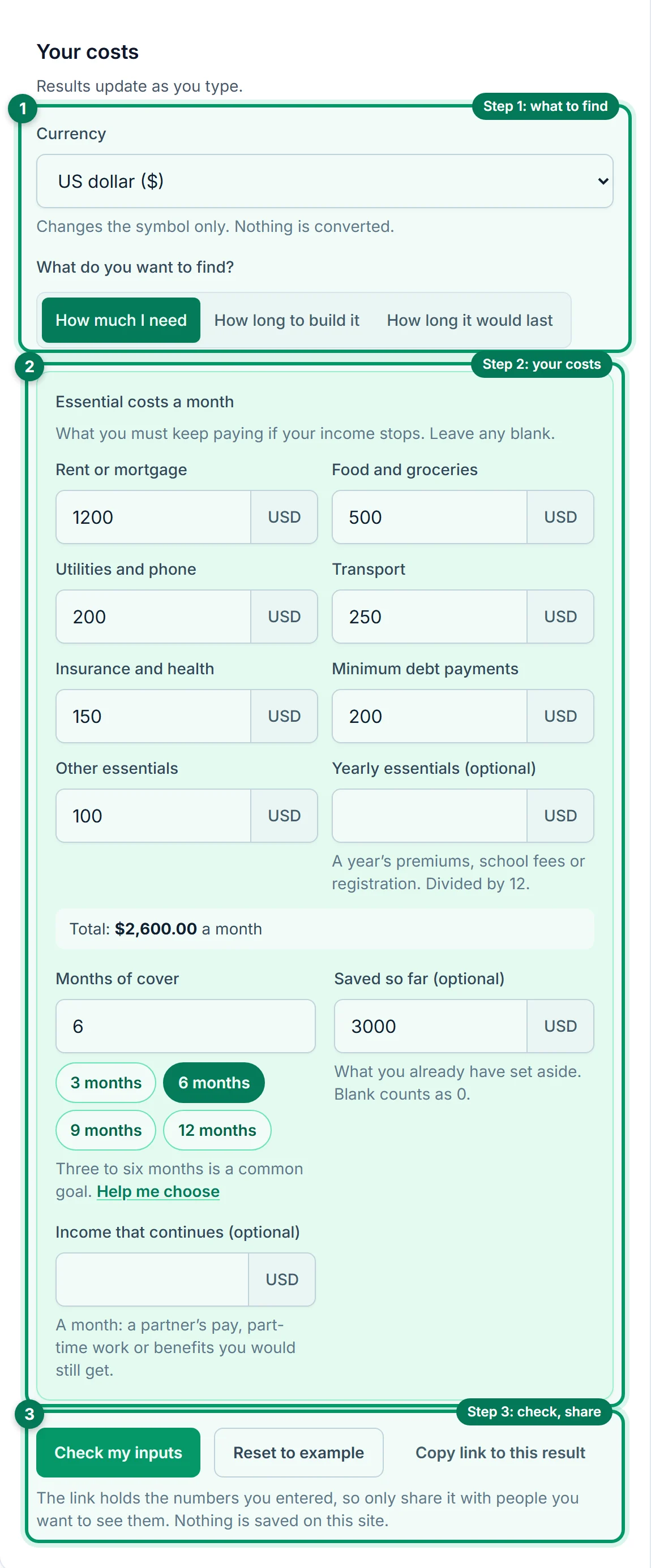
Pick your Currency. Under What do you want to find?, choose How much I need, How long to build it or How long it would last.
Enter your essential costs
Fill in what you must pay each month, from Rent or mortgage to Other essentials; leave any blank, and add Yearly essentials if you have them. Choose the Months of cover, or use Help me choose, and enter what you have Saved so far and any Income that continues. To build the fund, add the Amount you can save and when you Start on.
Read or share the result
Results update as you type. Check my inputs points to anything that needs fixing, and Copy link to this result gives a link with your numbers in it.
Your results, explained
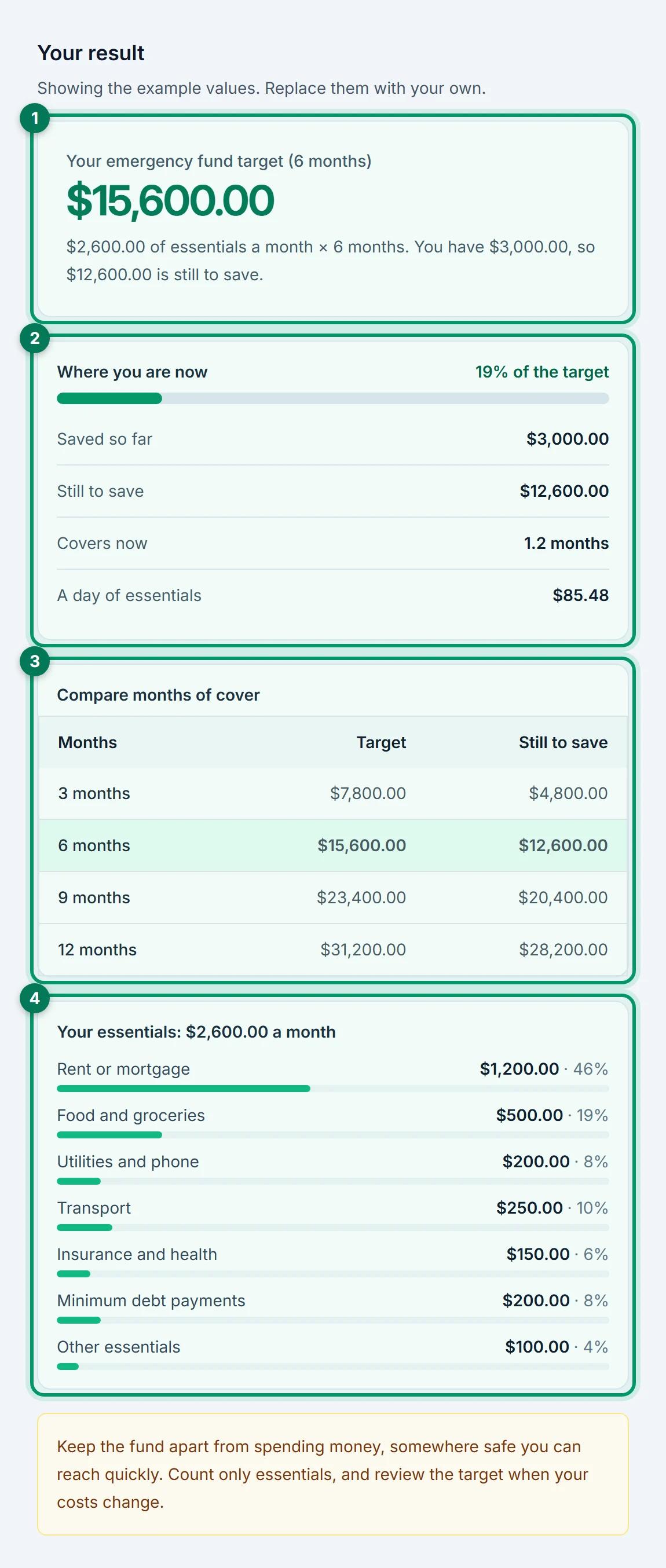
Here are the results for the example values: 2,600 a month of essentials, six months of cover and 3,000 saved. Each numbered explanation matches a highlighted area in the image.
1. Your target: 15,600
Six months of essentials: 2,600 a month × 6 = 15,600. With 3,000 already saved, 12,600 is still to save. Essentials are the costs you must keep paying if your income stops.
2. Where you are now
The 3,000 you have is 19% of the target and covers about 1.2 months of essentials, at 85.48 a day. The bar shows how far you have come.
3. Compare months of cover
The same essentials at 3, 6, 9 and 12 months: 7,800, 15,600, 23,400 and 31,200, with what is left to save for each. Choose more months if your income is less steady.
4. Your essentials
Each cost and its share of the 2,600. Rent is 1,200, 46% of the total, so it drives the size of the fund. Trimming a cost here lowers the target for every month of cover.
How each mode works: inputs and results
The calculator has three modes, chosen under What do you want to find? Pick a mode below to see exactly what it needs and what it shows. All three work with Copy link to this result.
Answers: How big should my emergency fund be?
Inputs
| Input | What to enter |
|---|---|
| Essential costs a month | Rent or mortgage, food and groceries, utilities and phone, transport, insurance and health, minimum debt payments and other essentials. Leave any blank. Example: 1,200; 500; 200; 250; 150; 200; 100 |
| Yearly essentials (optional) | Costs paid once a year, such as insurance premiums or school fees. Divided by 12 and added to the monthly total. Example: Blank, or 24,000 |
| Months of cover | How many months the fund should last. Pick 3, 6, 9 or 12, type your own, or use Help me choose. Example: 6 |
| Saved so far (optional) | What you already have set aside. Blank counts as 0. Example: 3,000 |
| Income that continues (optional) | Money that would still come in each month: a partner’s pay, part-time work or benefits. The fund covers the rest. Example: Blank, or 1,000 |
Results
| Result | What it tells you |
|---|---|
| Your emergency fund target | The main result: monthly essentials × months of cover, and what is still to save. |
| Where you are now | What you have as a share of the target, and the months and days of essentials it covers. |
| Compare months of cover and Your essentials | Targets at 3, 6, 9 and 12 months, and each cost’s share of your essentials. |
The maths
Monthly essentials = costs a month + yearly essentials ÷ 12
To cover each month = monthly essentials − income that continues
Target = to cover each month × months of cover
Still to save = target − saved so far
A day of essentials = costs a month × 12 ÷ 365
Example
2,600 a month of essentials for 6 months: a 15,600 target. With 3,000 saved, 12,600 is still to save.
Answers: If I save a set amount, when will my emergency fund be ready?
Inputs
| Input | What to enter |
|---|---|
| Essential costs, Months of cover, Saved so far, Income that continues | As in How much I need: they set the target. Example: 2,600 a month; 6; 3,000 |
| Amount and Each | What you can put aside, and how often: each day, week, payday (the 15th and the last day of the month) or month. Example: 250 each payday |
| Start on | The day you start saving. Today fills in your date. Example: 2027-01-01 |
Results
| Result | What it tells you |
|---|---|
| Your emergency fund is ready on | The main result: the date of the saving that completes the fund, and how many it takes. |
| Milestones | The dates your fund first covers 1, 3 and 6 months of essentials. |
| Plan it day by day | Opens the same plan in the Daily Savings Goal Calculator, with a printable tracker and calendar reminders. |
The maths
Savings needed = (target − saved so far) ÷ amount, rounded up
The last saving is whatever is left
Example
Saving 250 each payday from 1 January 2027 reaches the 15,600 target on 15 February 2029: 51 paydays, the last one 100.
Answers: If my income stopped today, how long would my savings cover my essentials?
Inputs
| Input | What to enter |
|---|---|
| Essential costs a month and Income that continues | As in How much I need. Only the part not covered by income is drawn from the fund. Example: 2,600 in total |
| Your emergency fund | What you have set aside now. Example: 3,000 |
| Income stops on | The first day without income. Today fills in your date. Example: 2027-01-01 |
Results
| Result | What it tells you |
|---|---|
| Your emergency fund would last | The main result: the whole days of essentials your fund covers, and the last day covered. |
| Your essentials | Each cost and its share, to see where cutting back stretches the fund furthest. |
The maths
Days covered = fund ÷ (to cover each month × 12 ÷ 365), rounded down
Months covered = fund ÷ to cover each month
Example
3,000 against 2,600 a month of essentials lasts 35 days, about 1.2 months: from 1 January to 4 February 2027.
Worked example: ₱28,000 a month, built on paydays
A household in the Philippines spends ₱28,000 a month on essentials: ₱8,000 rent, ₱9,000 food, ₱3,000 utilities, ₱3,000 transport, ₱1,500 insurance and health, ₱2,500 loan minimums and ₱1,000 other. They have ₱20,000 saved. These figures are illustrative.
Six-month target = ₱28,000 × 6 = ₱168,000
Still to save = ₱168,000 − ₱20,000 = ₱148,000
At ₱5,000 each payday: ₱148,000 ÷ ₱5,000 = 29.6, so 30 paydays, the last ₱3,000
Starting 1 January 2027, the fund is ready on 31 March 2028
Saving on paydays, the 15th and the last day of the month, fits how many people in the Philippines are paid. Moving the ₱5,000 as soon as the salary arrives makes it hard to skip.
How many months of cover?
Three to six months of essentials is a common goal. Where you land depends on how quickly you could replace your income and who depends on it:
| Your situation | Consider |
|---|---|
| Two steady incomes, no dependants | 3 months |
| One steady income, or a family to support | 6 months |
| Irregular income: freelance, commission, seasonal or contract work | 9 to 12 months |
| Just starting out | 1 month first, then build up |
Not sure? Select Help me choose under Months of cover: answer two questions about your income and who relies on it, and the calculator suggests a number of months.
If some income would continue, such as a partner’s pay, enter it under Income that continues: the fund only needs to cover the rest. With 1,000 a month still coming in, the example’s six-month target falls from 15,600 to 9,600.
A small fund helps straight away: even one month of essentials keeps a surprise bill off a credit card while you build the rest.
Where to keep your emergency fund
The fund needs to be safe, quick to reach and separate from everyday spending, so you are not tempted to dip into it. A savings account at a bank or credit union fits all three. A high-yield or digital bank account earns some interest while it waits; see what it earns each day with the Daily Interest Calculator, or compare accounts with the APY Calculator.
Avoid investments whose value can fall just when you need the money, and anything with a penalty to withdraw early, such as a time deposit, for the part you may need quickly.
Before relying on the result
- Essentials only. Count what you must pay, not your usual spending; it keeps the target realistic.
- Irregular bills. Spread yearly costs, such as insurance premiums or school fees, into a monthly amount.
- Costs change. Review the target when rent, family size or loans change.
- It is not an investment. Keep the fund safe and reachable, even if it earns little.
Sources
- FINRA: How to Prepare for and Survive Financial Hardship Supports three to six months of savings as a good emergency fund goal (published 30 April 2024).
- Consumer Financial Protection Bureau: An essential guide to building an emergency fund Supports starting small, setting a specific goal, and keeping the fund safe, accessible and apart from spending.
Sources checked on 21 November 2026.
Frequently asked questions
How much should I have in an emergency fund?
What counts as an essential cost?
What if some of my income would continue?
What about costs I pay once a year?
Should I save my whole salary or only essentials?
How long does it take to build?
Where should I keep my emergency fund?
Should I build an emergency fund or pay off debt first?
Is anything saved when I copy a link to my result?
Does changing the currency convert my amounts?
Related interest and savings calculators
Keep planning with the tools that answer the next question.
- Daily Interest CalculatorSee what a balance earns or costs each day, compare two rates, or check a statement. Open calculator
- Daily Compound Interest CalculatorSee money grow with interest added every day, the days to a goal, or the daily rate needed. Open calculator
- Daily Savings Goal CalculatorFind how much to save each day, week or payday to reach a goal by a date. Open calculator
- 52-Week Savings Challenge CalculatorPlan the 52-week challenge, weekly or on paydays, with a printable tracker. Open calculator
- Sinking Fund CalculatorSave ahead for insurance, school fees and other planned costs, fund by fund. Open calculator
- Time to Save CalculatorSee how long a goal takes and the date you reach it, saving each day, week, payday or month. Open calculator
- APY CalculatorConvert an APR to APY for any compounding, or compare two savings accounts. Open calculator
- Simple Interest CalculatorFind simple interest, or the rate, time or principal behind it, and check add-on loans. Open calculator
- CD CalculatorSee what a certificate of deposit is worth at maturity, or what withdrawing early costs. Open calculator
- Credit Card Interest CalculatorSee how long a card takes to pay off, what paying more saves, or one month’s interest. Open calculator
- Average Daily Balance CalculatorAverage a balance over a statement period, or see what to deposit to meet a maintaining balance. Open calculator
- CAGR CalculatorFind the yearly growth rate between two values, or project one forward. Open calculator
- Dividend Reinvestment CalculatorSee how income grows when every payout is reinvested. Open calculator